Finding in only 5 days a solution to make the digital press profitable
How I have devised an app to contrast a piece of news in all media, designed the prototype and tested it with users.
Finding in only 5 days a solution to make the digital press profitable
DESIGN SPRINT
Role
UX / UI designer
Team work/ Individual work
Time
1 week
Tools
Figma
Skills
Sprint Questions | Assumptions | HMW questions | Affinity maps | Benchmarking | Wireframes | User Tests
Role
UX / UI designer
Team work / Individual work
Time
1 week
Tools
Figma
Skills
Sprint Questions | Assumptions | HMW questions | Affinity maps | Benchmarking | Wireframes | User Tests
THE PROBLEM
How to transform the general information media (the press)?
The press sector is undergoing a radical transformation since the appearance of the internet. The printed press is losing revenue as the press run decreases, as well as the advertising revenue that is being taken by social networks and Google.
Our challenge was to develop ideas that improve the current situation with a user-centric approach.
THE RESULTS
I have created an app that compares the news in all the media in the world
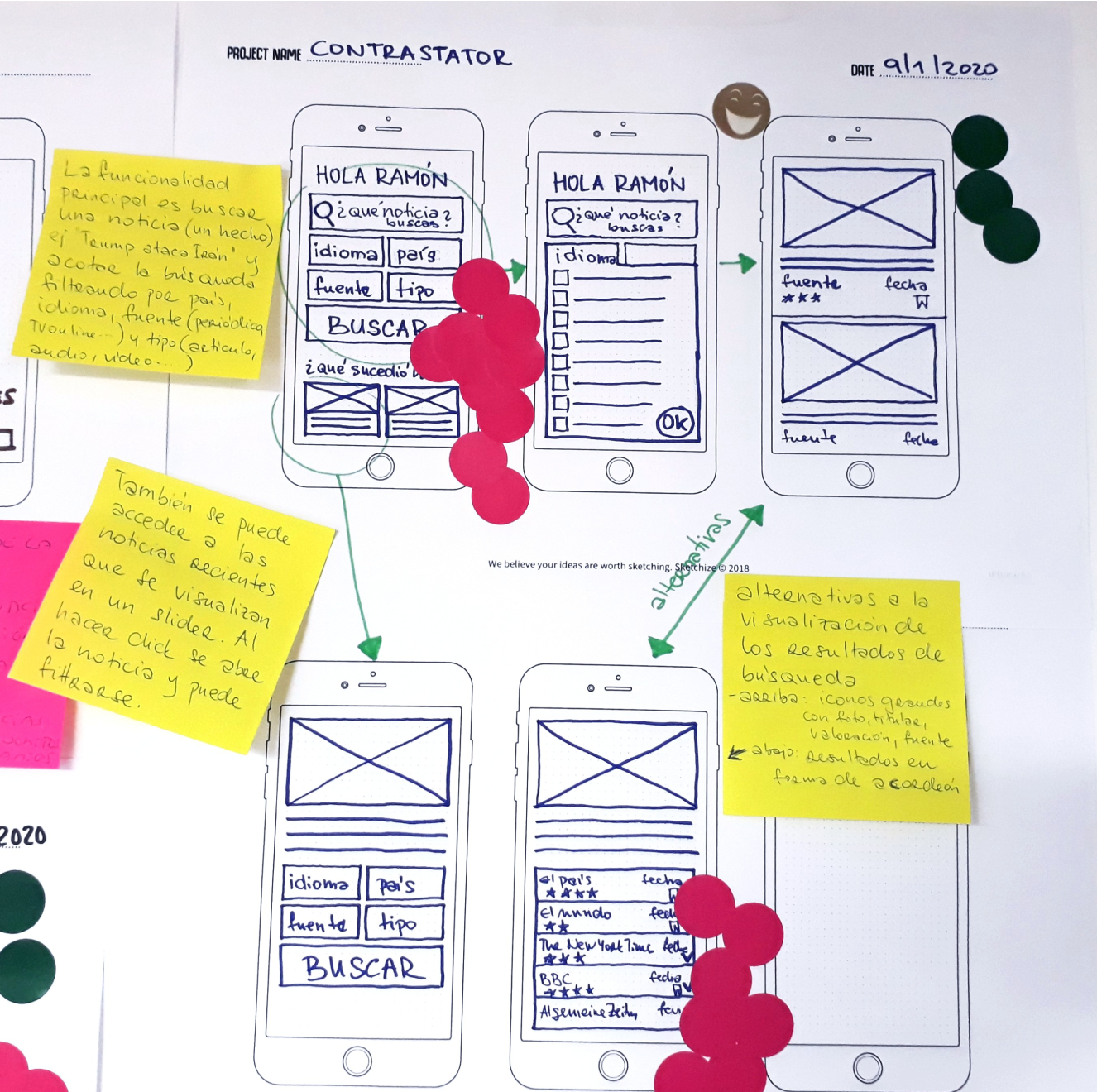
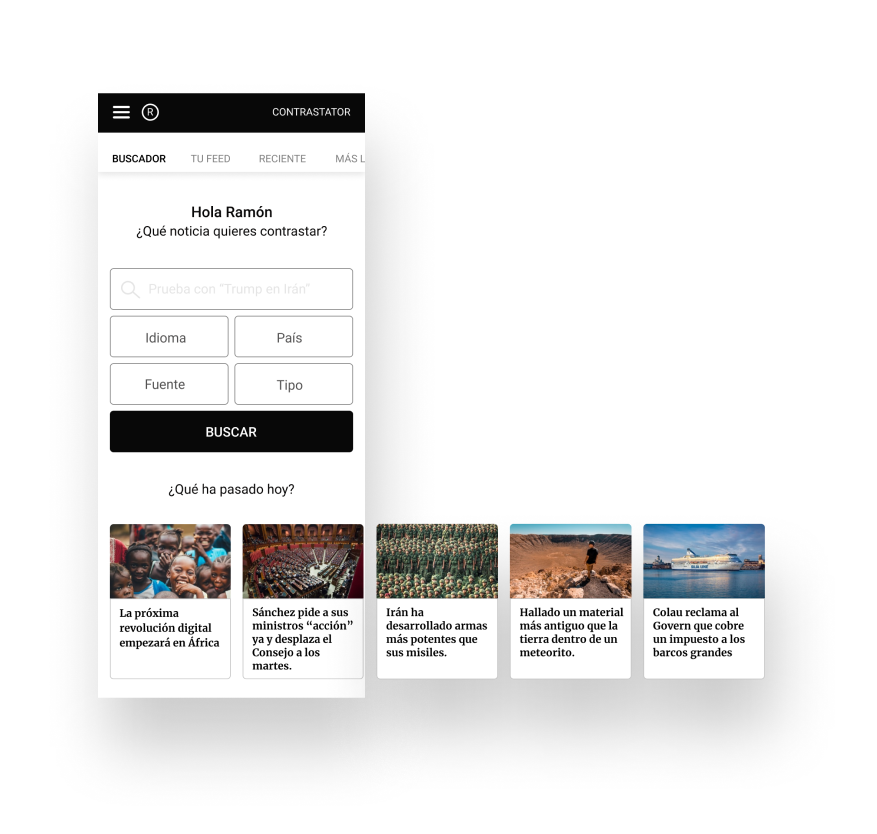
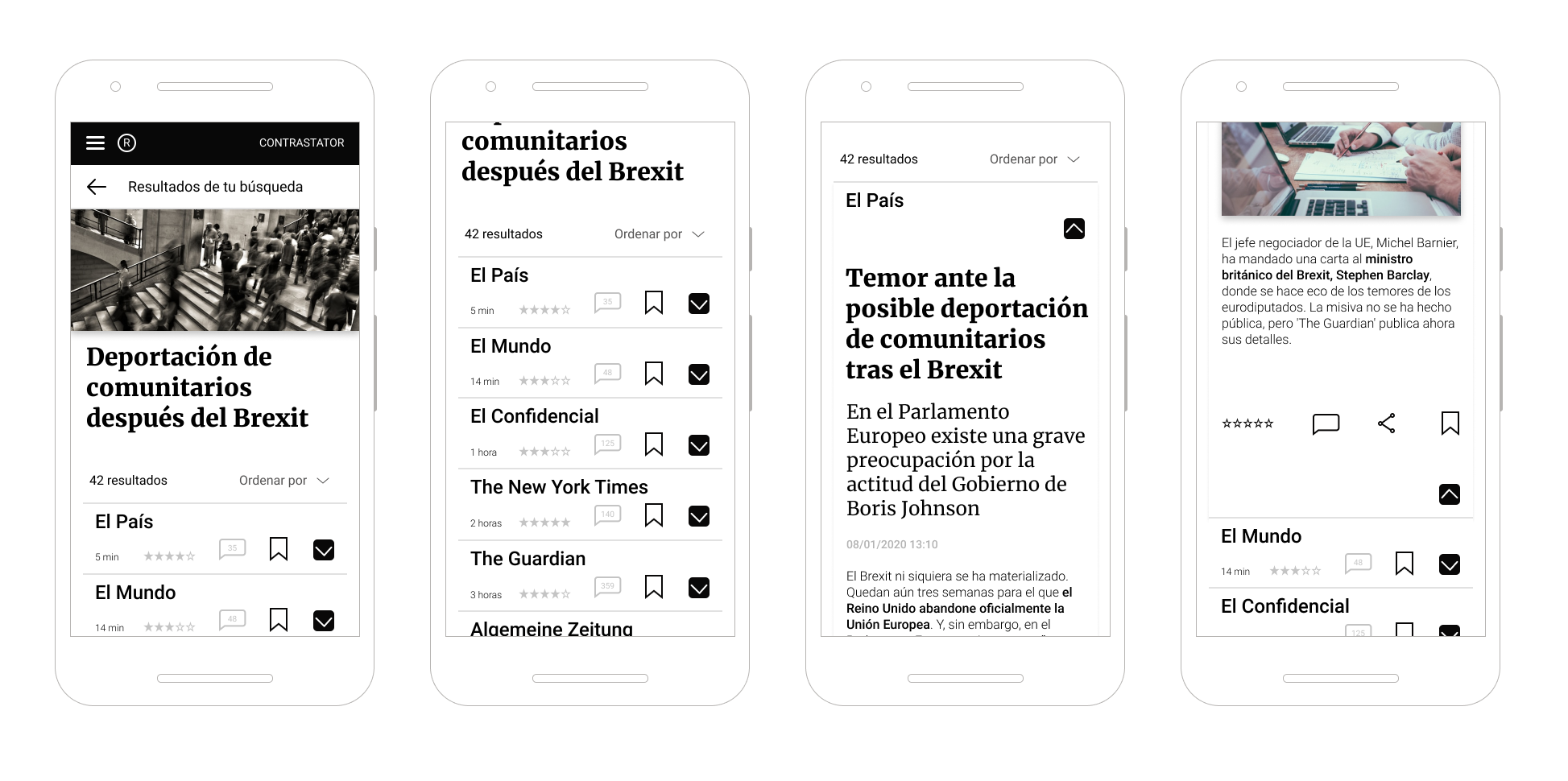
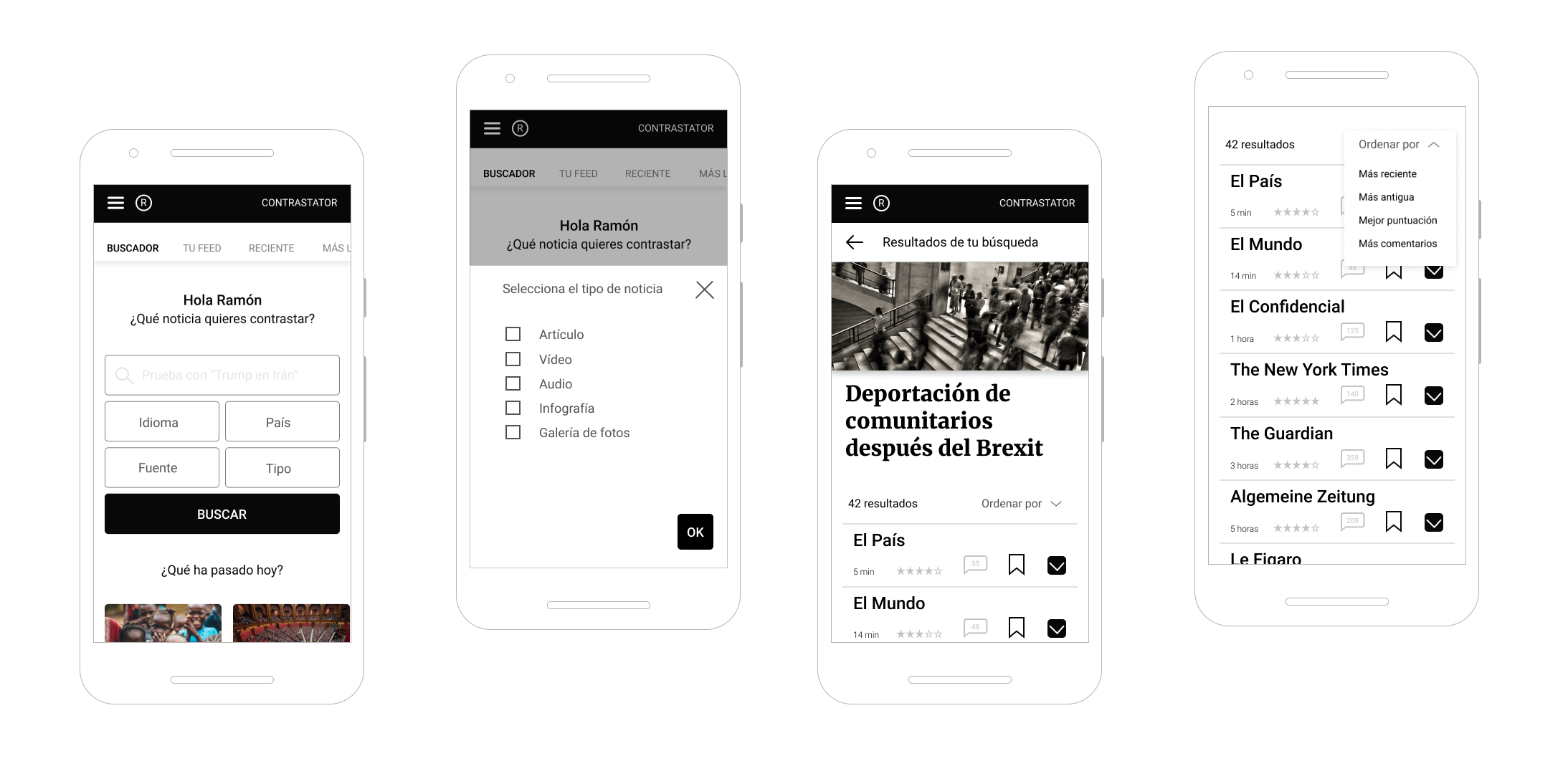
The main functionality of The Contrastator is the search engine or rather the news comparator, where you can filter the news by language, country, source or type (article, audio, video, etc).
I designed a prototype and tested it with users
I designed the screens that were necessary for the purpose of the testing objectives: to validate the idea of the app, its usefulness and whether it would be possible to monetize.
I achieved to validate the idea and iterate the design
I did guerilla testing and managed to validate the idea. I detected opportunities for improvement and iterated the design.
THE PROCESS
Design sprint
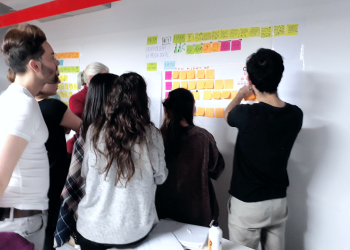
We started the sprint as a team of 8 people, in addition to the Facilitator and Decision-maker. From the wireframes design onwards I worked individually.
To understand
The teamwork was very productive, so on the first day we ended up with:
- a defined goal: Making the digital press profitable,
- a list of Sprint Questions (31 questions),
- user maps created,
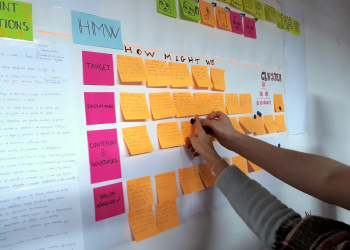
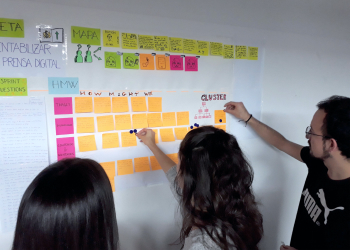
- our assumptions rephrased into How Might We Questions,
- and interviews with two experts working in Spanish press.
We ended up voting an idea that we would continue developing:
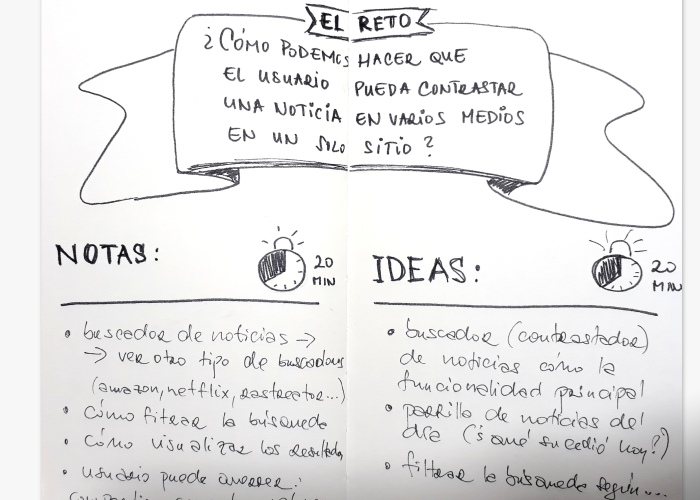
How might we achieve that the user could compare a piece of news in several media on the same site (including international ones)?
Solutions
Working as a team helps to generate a large number of ideas or solutions from different points of view, which a person working alone could not reach.
I realized that having time constraints on all the tasks was one of the factors that helped us the most to keep moving forward.
Having a time limit forces you to focus and does not give rise to doubting the decisions made or starting to come up with a new idea, which are usually the causes of the endless process.
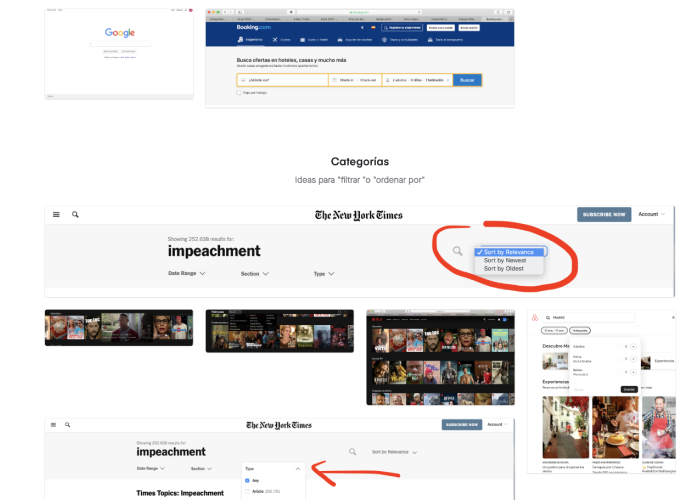
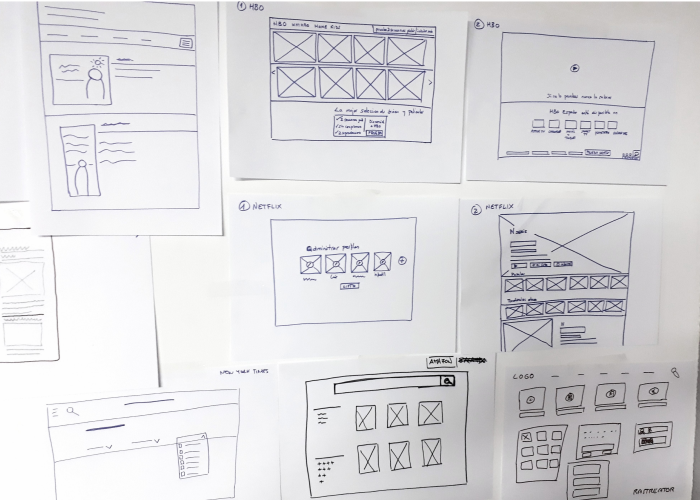
So on the second day we were able to do benchmarking and quick demos. From there, in two 20-minute blocks, we have taken notes and written down ideas, each one separately. In just 8 minutes we made 8 sketches of our ideas (crazy 8). Half an hour later, each member of the team had a wireframe with their proposed layout.
Decide
Making important decisions is never easy. Or is it?
On the third day of the sprint, we made team decisions with almost no effort. It was very interesting to see how the Facilitator understands our sketches correctly. And to see the number of different solutions to the same problem was amazing.
Voting by stickers, creating the heatmap and finally the silent vote made it much more relaxed and even fun for the team to make decisions.
The chosen solution was: The Contrastator
The Contrastator
It would be an app with which you can compare a piece of news or fact (for example attacks on Iran) from all sources in the world. We know that each newspaper dyes the news in a certain color, and the best way to form an opinion is to be able to access the same news from various sources.
The main functionality of The Contrastator would be the search engine or rather the news comparator, with the possibility of filtering the news by language, country, source or type (article, audio, video …).
A multiple selection is available, for example, choosing Spanish and English languages, and then in countries choosing Spain, Mexico, Argentina, USA and Canada. So in the search results would appear all the articles that talk about attacks in Iran that were published in the selected countries in both languages.
Prototype
The prototype has to serve its purpose. I consider this point especially important. We must be very clear about what aspects of our design we want to test with users, what is important and what is not.
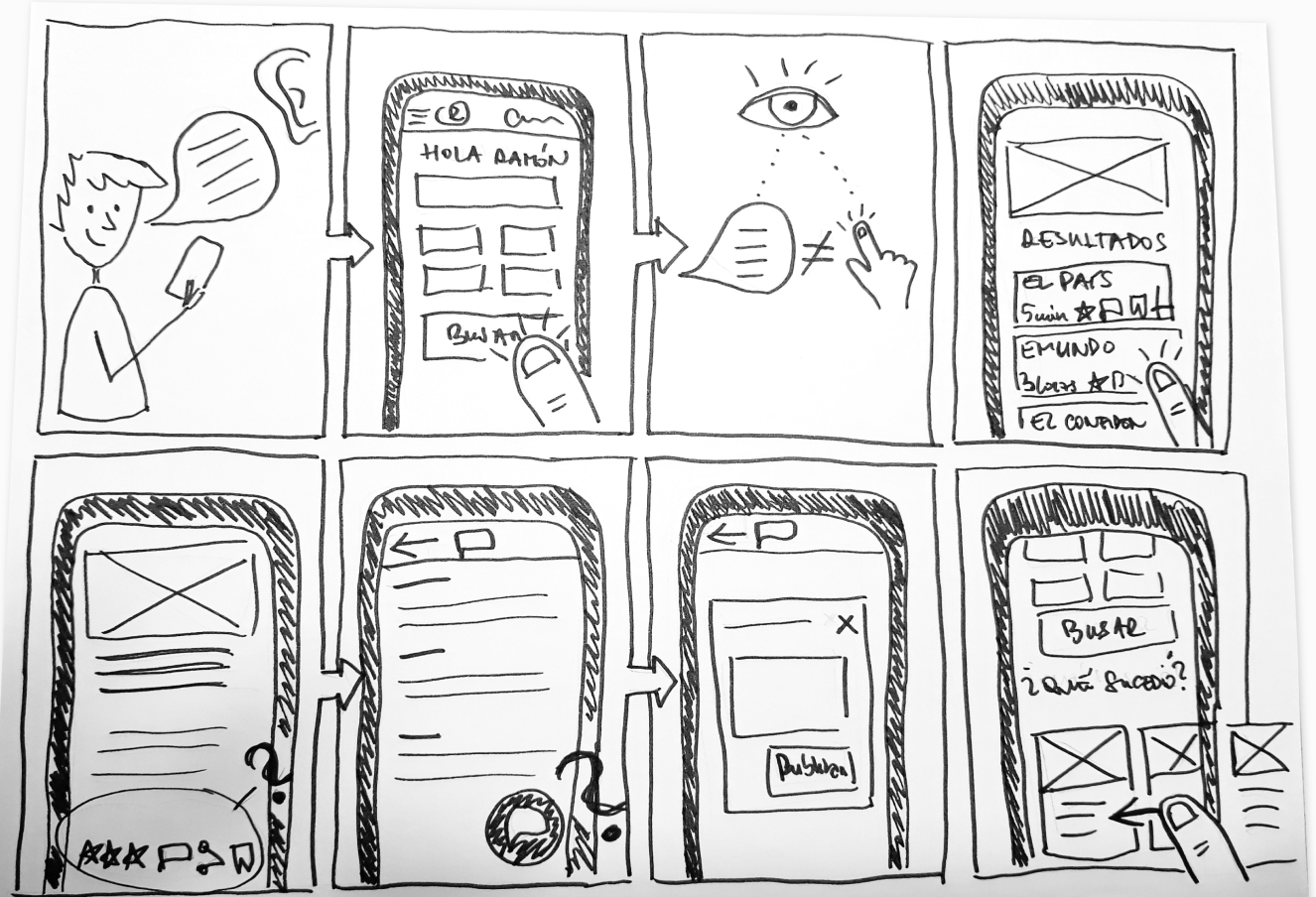
Storyboard can help us a lot. If we skip this part, we might get lost making a prototype that is too realistic, wasting time on creating parts which are not necessary for the testing. This is the best way to get a prototype ready in just one day.
Thanks to sketching a storyboard, I knew from which screen I should start the prototype. In the case of The Contrastator, the prototype would start with the user already logged in. There was no point in designing the sign in screens, because it wasn’t important for the purpose of this testing.
This doesn’t mean that in the case that the project would go ahead, this part wouldn’t have to be tested. Of course it would. But for the purpose of this Design Sprint, what I needed to validate was the idea of the app, its usefulness and whether there was a chance to monetize it.
Test
One of the things I learned in this project is: Test as soon as you can. Don’t wait for the prototype to be perfect, start validating your design.
Because after all:
You are not the user.
With the prototype ready I started to test. I did the informal testing also called the guerrilla test. Before starting, you have to plan the testing well. I asked myself the following questions:
What do I want to test?
It is necessary to be very clear about the objectives of testing, to know what I want to find out with the test. I needed to validate the idea of The Contrastator, if people would use it, find out if it was easy to use and know if users would pay for this service.
Who am I going to test with?
The first day we have drawn 2 user maps, Ramón 65 years old and Ana 25 years old. Now I was thinking about interviewing these two groups of users. I remembered a phrase from the documentary Objectified which I have seen few days before:
“Once you understand how the extremes are, the average will sort itself out.”
Where to look for test candidates?
If you do a guerrilla test, it’s a good idea if you go out into the streets. Interviewing your colleagues and family probably won’t bring you relevant answers, as they might not want to hurt your feelings by telling you what they really think.
You can try for example in cafes, of course, it depends on how good you are approaching unknown people. In my case I did the testing in the hostel where I was staying, which provided me with a good culture of samples for my experiment.
According to Jakob Nielsen, a test with 5 users reveals 85% of usability problems. To discover all the usability problems of your design, you need to test with 15 users, but in groups of 5 and iterate in between.
When you have several groups of users with a very marked difference, it is not necessary to include so many users in each group.
In my case, to test three user groups (65, 30-40, 25) three users for each group would be enough.
Eventually, I got four users between 30 and 40 years old and two 25 years old users. It was not what I intended, but it was a good sample to get the feedback I was looking for.
What to ask?
I designed several groups of questions:
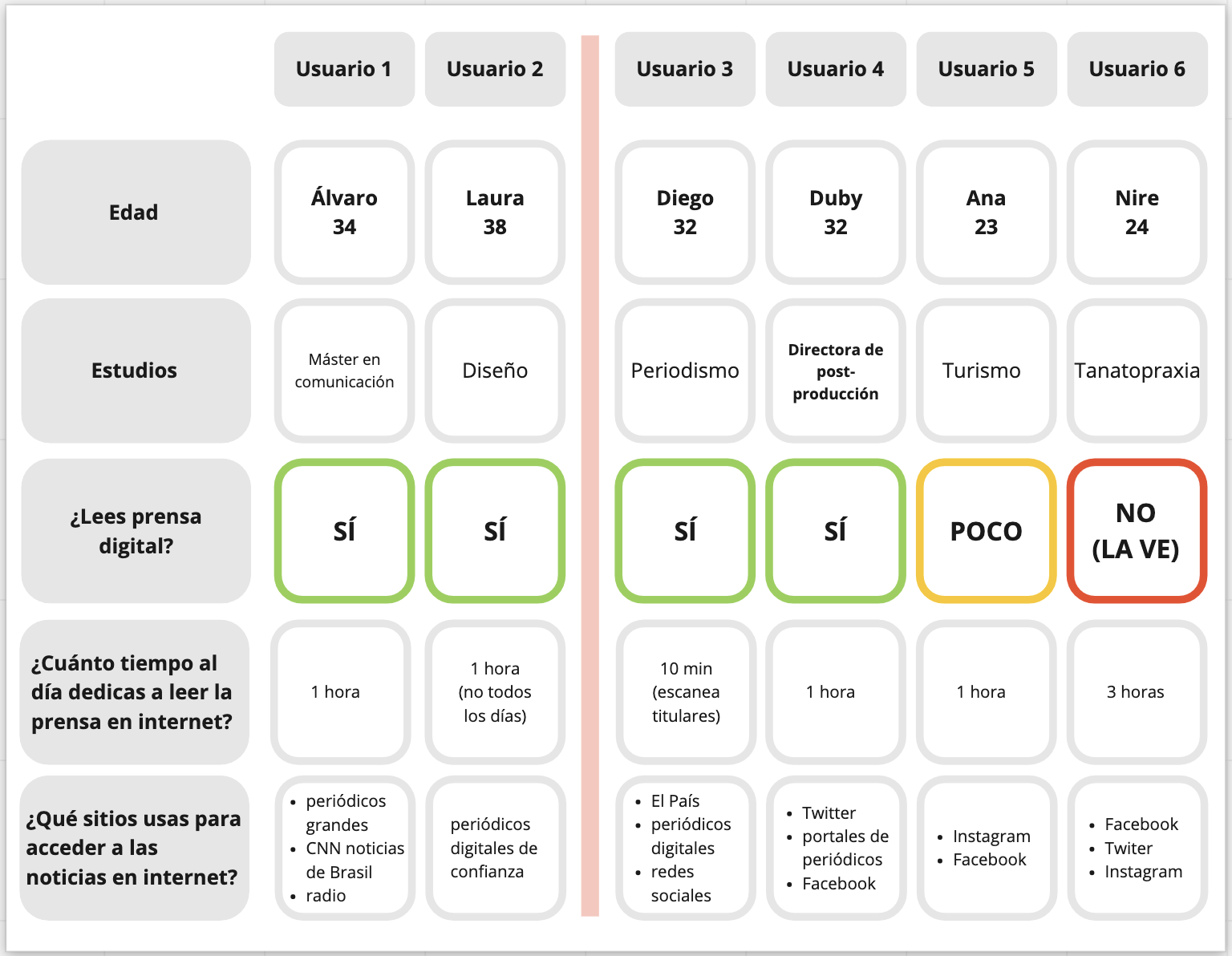
First, a series of questions to assess whether the interviewed users were suitable for the test.
Then I continued with a series of open questions, combining the technique of “listening and observing” and I began to notice the difference between what the users were telling me and what they were doing.
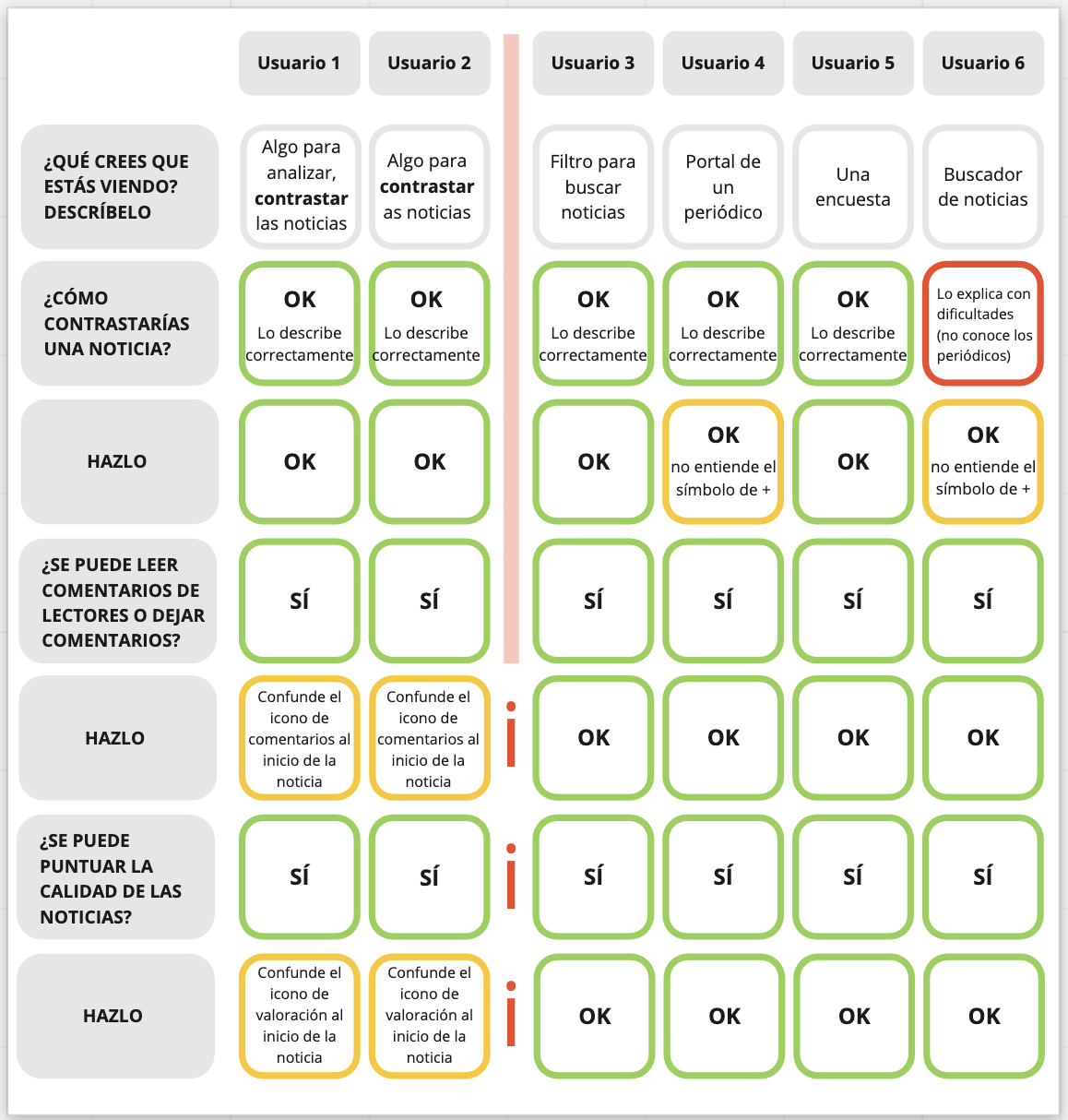
After having done the tests with the first two users I noticed a design error that led to confusion (the false affordance). I decided to iterate before continuing to test with more users. You might think that it was too early to iterate after two tests. But when observing the behavior of the users I was sure that the same thing was going to repeat with the third user and I wanted to see if I could solve it. I was right. After the iteration the error didn’t repeat.
Later I found out a few more things. Among others, that the last user was not a suitable candidate for this test, since it turned out that apart from El País that her father read, she didn’t recognize any other newspaper.
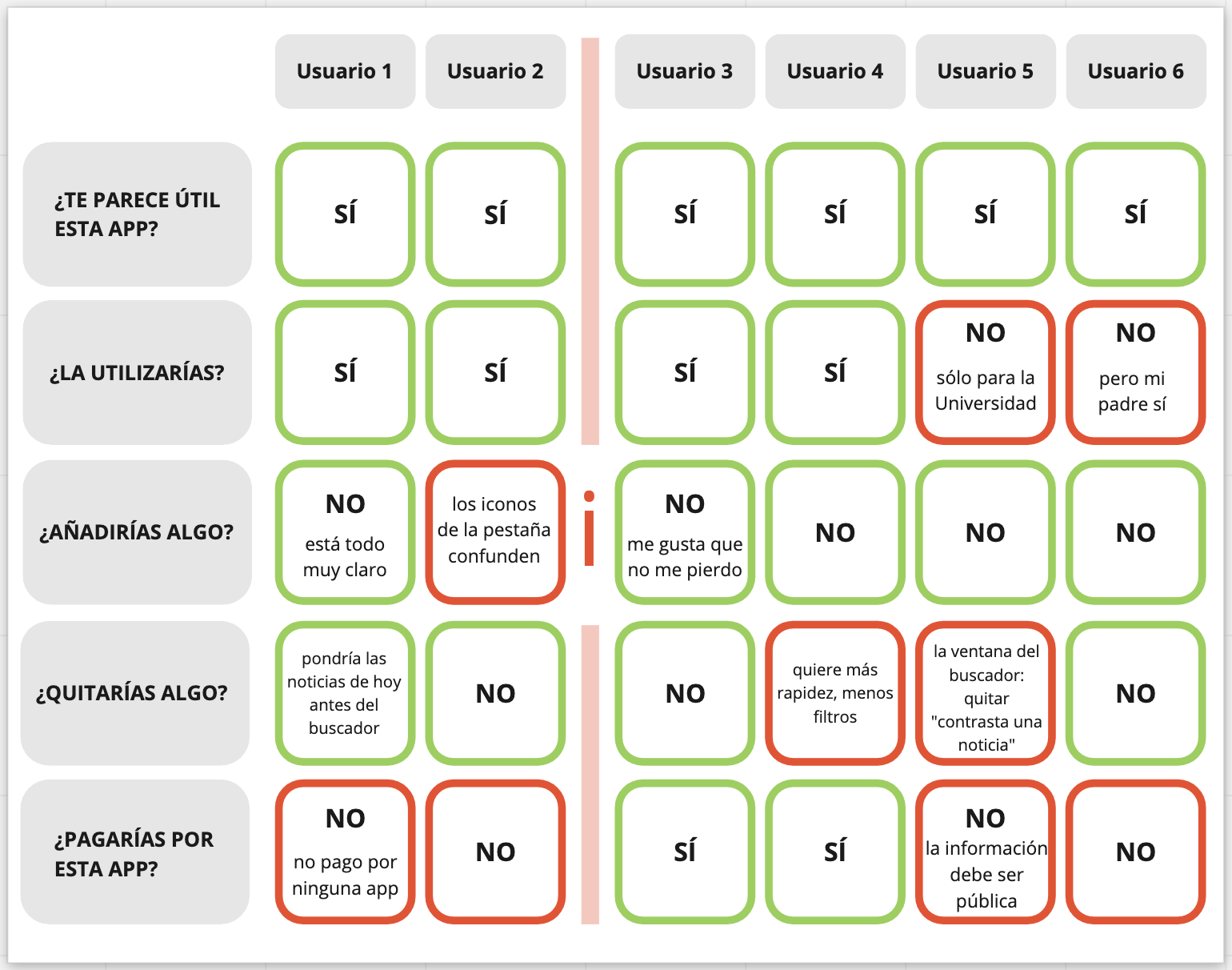
The following group of questions helped me to evaluate what the users thought of the idea in general, if they would use the app, and especially if they would pay for it.
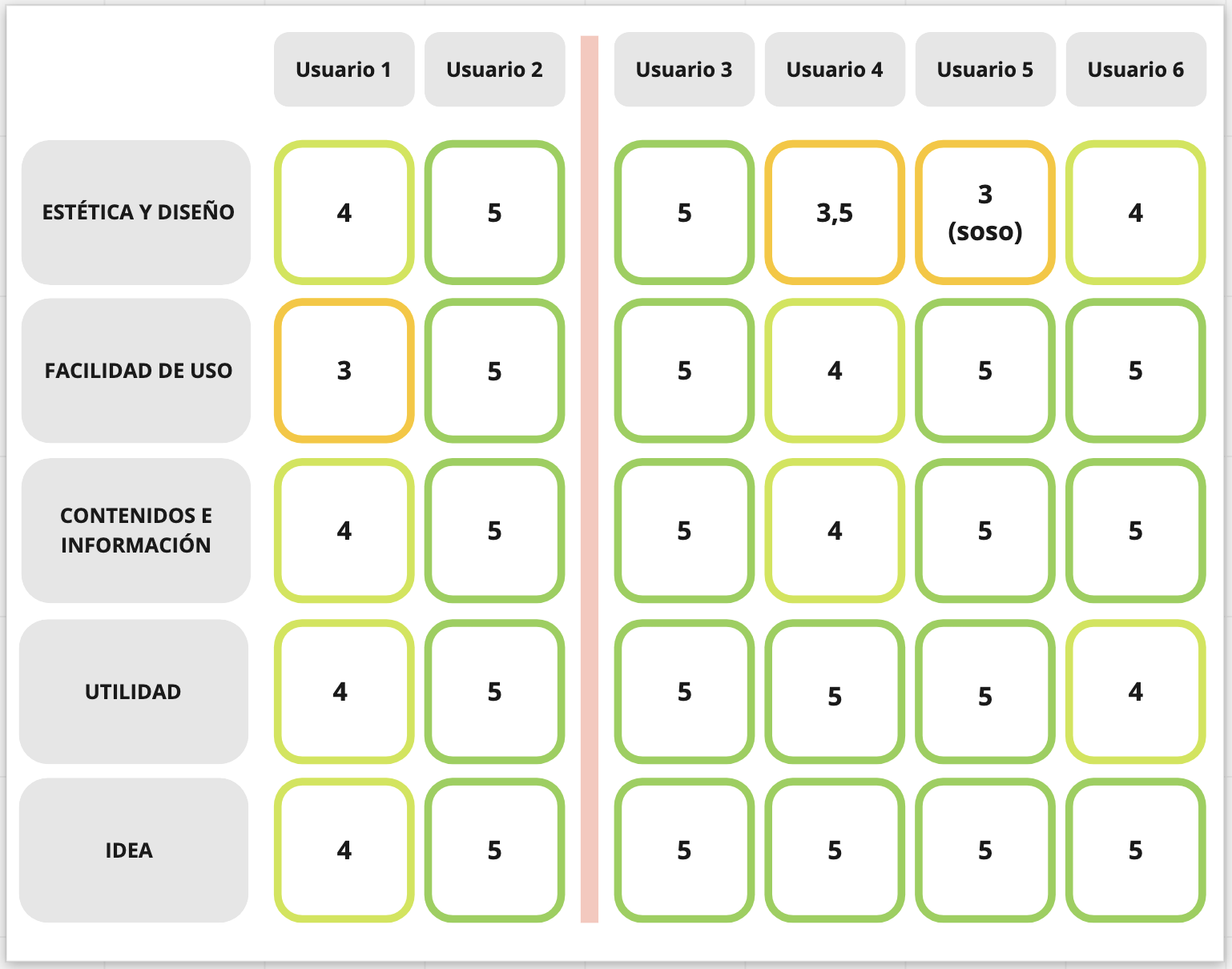
The last group of questions was to quickly assess aesthetics and design, ease of use, utility and the idea on a scale of 0 to 5.
I have to point out that the first users ease of use evaluation can be affected by testing with the Figma Mirror and delays in loading. After testing with this user I decided to do the tests on the laptop with the rest of the users.
Improvement opportunities that I detected:
- the + sign to read more was not understood by two of the users
- the bookmark sign was not understood by two of the users
- improve design and aesthetics
"I find it useful for important news, to read it all on one site and to be able to draw my own conclusion."
"I like that I don't get lost."
"Now I'm manually comparing the news."
"I find it comfortable, easy to navigate especially for the previous generation, used to the printed press."
"I like that the advertisement that usually moves everything, doesn’t pop up."
"I like to compare the news."
Testing conclusions
In general, users rated The Contrastator positively. Especially the idea, utility and ease of use. I think that in this respect I can say that I managed to validate the idea.
On the other hand, only two users said they would pay for this service, so it would not serve the goal that we have set initially (to make the digital press profitable). However, I think it is possible to find a way to monetize this tool, either with non-intrusive advertising or by tailoring it to a very specific audience that would be willing to pay for it.