Creating a solution to improve sex education in Spain
How we have devised an educational program, whose main tool is an app, to improve sex education in Spain.
Creating a solution to improve sex education in Spain
How we have devised an educational program, whose main tool is an app, to improve sex education in Spain.
DESIGN THINKING
Role
UX / UI designer
Research, Flowcharts, UI design, Design System
Team of 4 designers
Skills
Desk Research | Questionnaires | Interviews | User Personas | Flowcharts | Information Architecture | Wire flows | Design System
Time
14 days
Tools
Paper | Gitbook | Miro | Google Forms | Xtensio | Whimsical | Photoshop | Illustrator | Figma
Role
UX / UI designer
Research, Flowcharts, diseño UI, Design System
Team of 4 designers
Skills
Desk Research | Questionnaires | Interviews | User Personas | Flowcharts | Information Architecture | Wire flows | Design System
Time
14 days
Tools
Paper | Gitbook | Miro | Google Forms | Xtensio | Whimsical | Photoshop | Illustrator | Figma
THE PROBLEM
In the 21st century in Spain, sex education is still a pending subject.
With the educational reform in 2013 (LOMCE) all content related to sexuality was eliminated from the Spanish academic curriculum.
Increasingly busy parents spend less time educating their children.
Most of our young people seek sexuality education through: friends, television, and porn (33% of boys and 17% of girls use porn to learn about sex).
What is going wrong?
The schools? Parents? The misuse of technologies?
We were looking for an innovative solution that meets the needs of today’s adolescents and satisfies parents and teachers who are increasingly concerned about the lack of involvement on this issue.
THE RESULT
We have devised an educational program whose main tool is an app
An educational program, promoted from schools, that joins parents and children, so that they learn together in confidence.
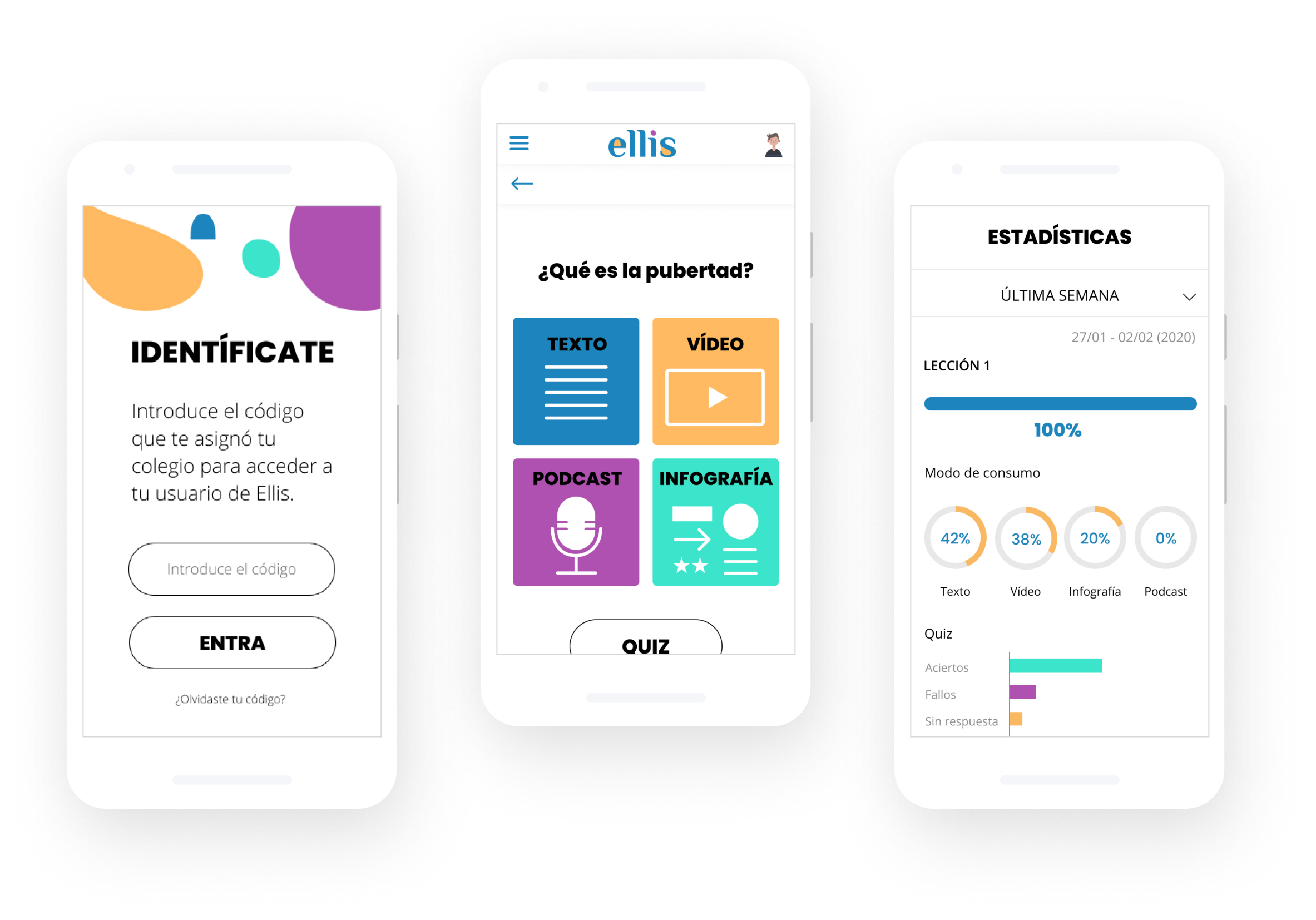
The program is based on an app as the main learning tool. There are 3 profiles to access: Juniors, Parents and Teachers.
We have prototyped 3 different app interfaces, website and promotional bus
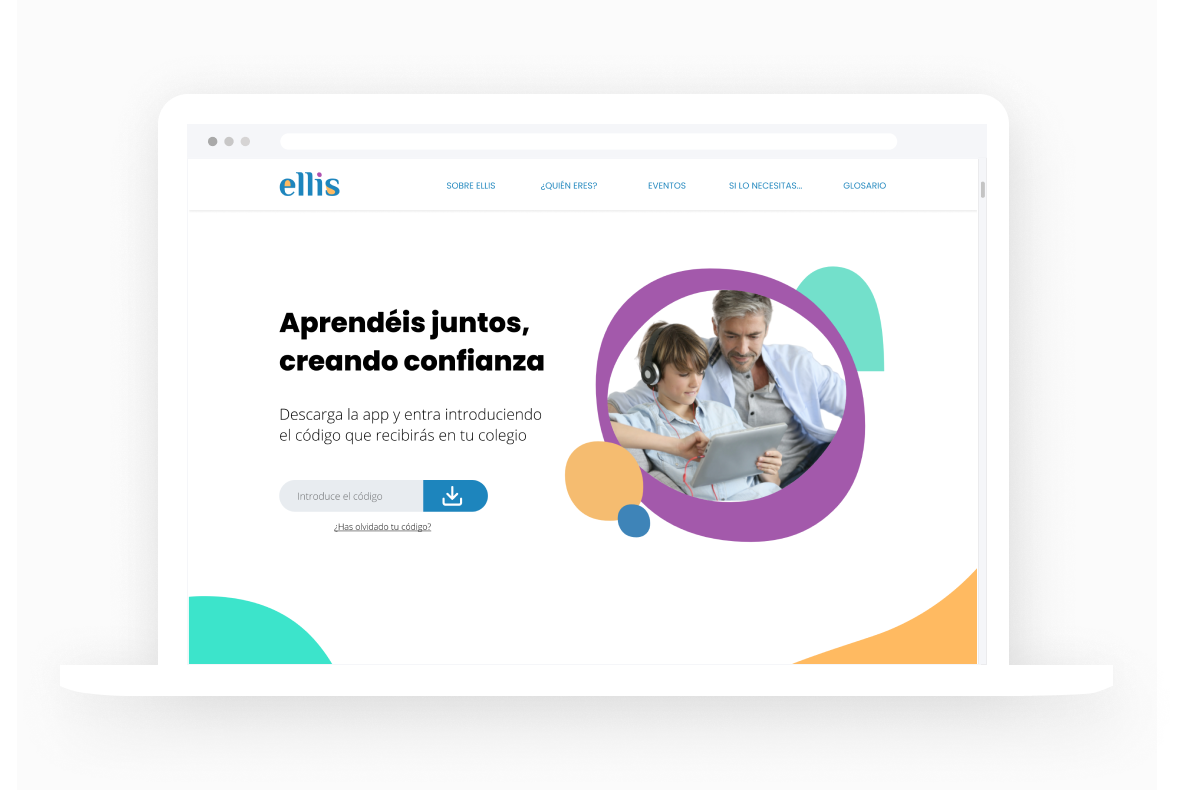
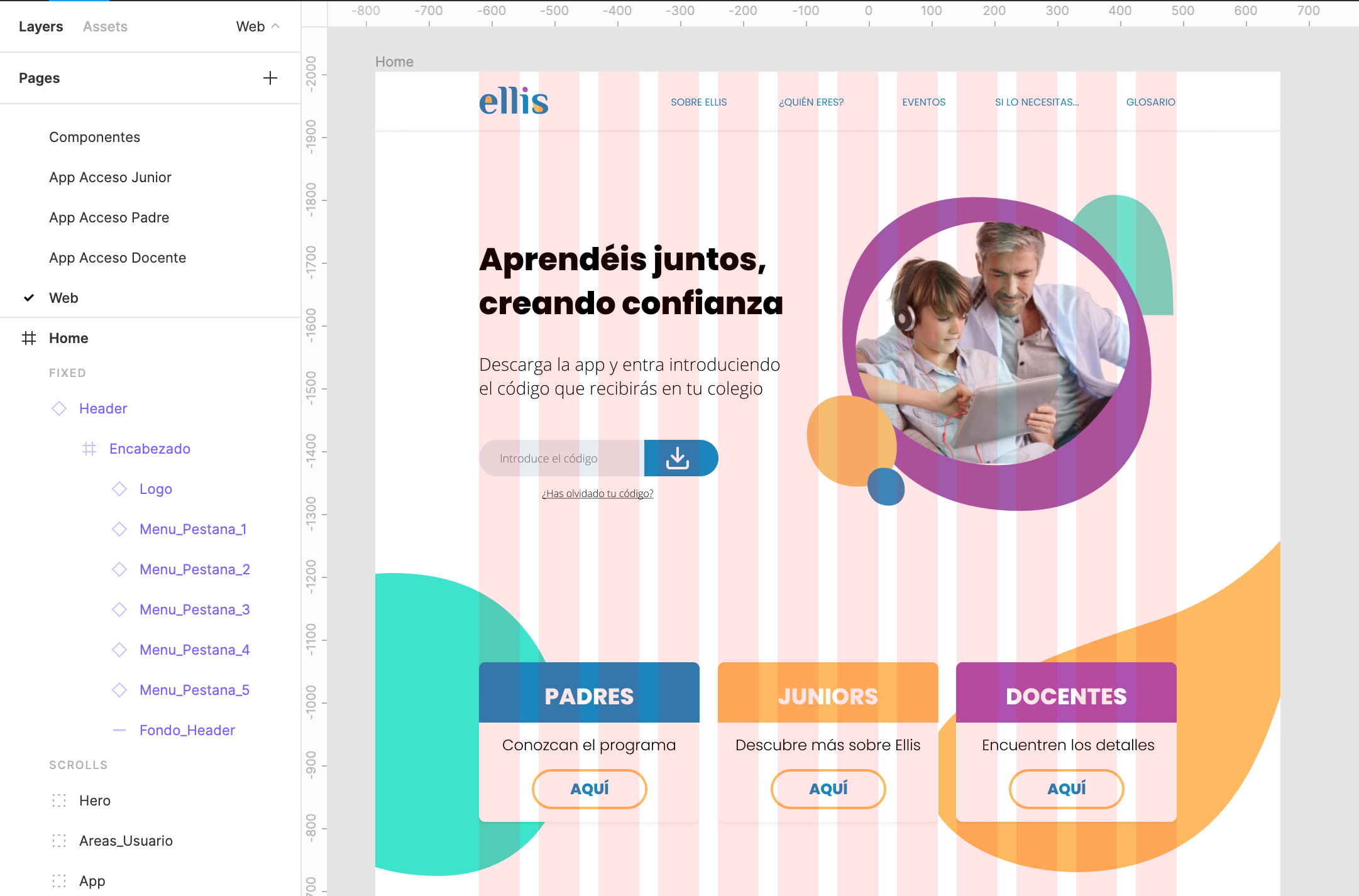
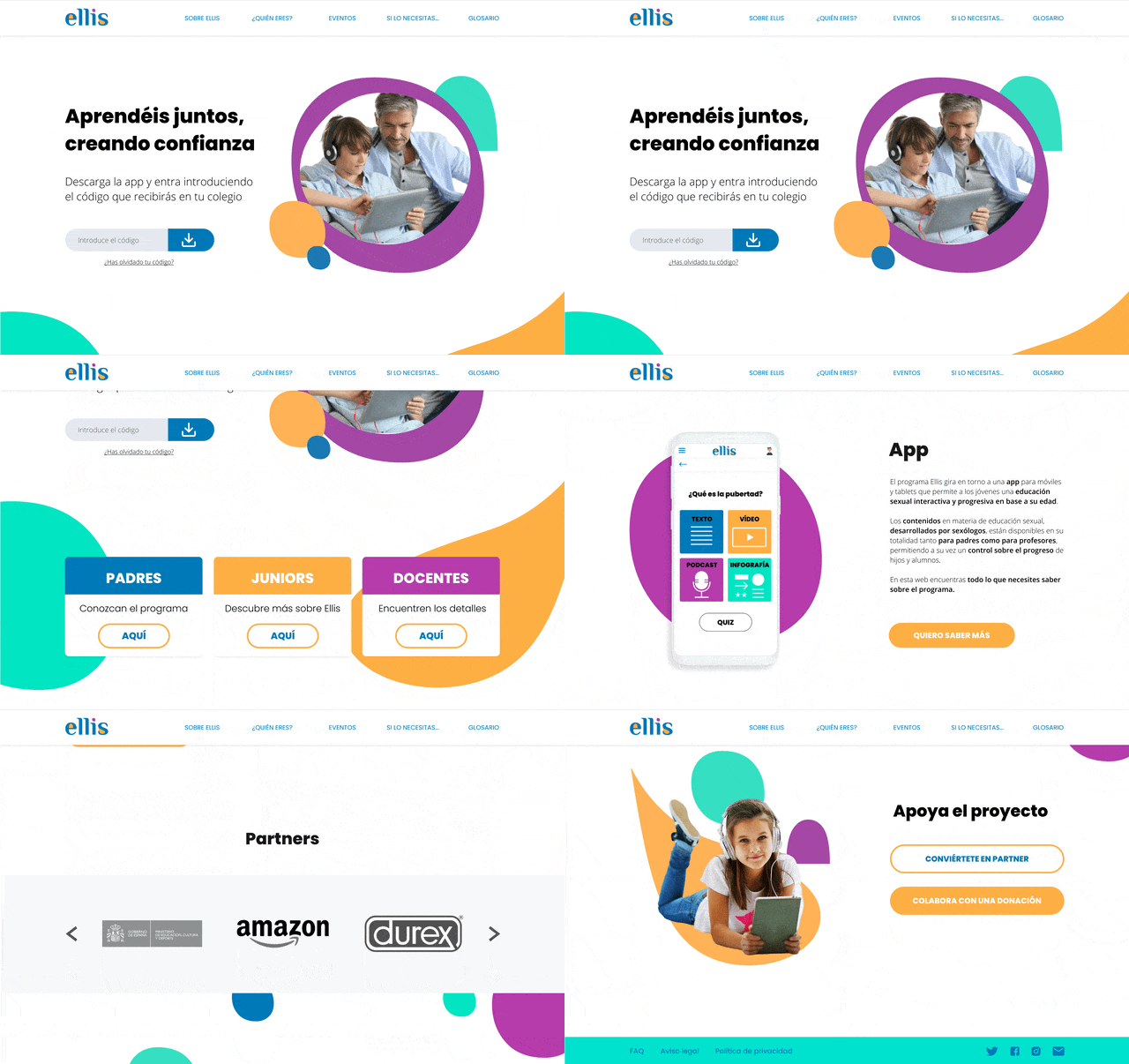
On the web you can download the application by entering the access code. It also provides supporting information.
The promotional buses go across all the provinces and carry out activities between students and parents.
THE PROCESS
Looking for a disruptive solution.
To improve the current situation, we have worked as a team applying the Design Thinking methodology and its Double Diamond model.
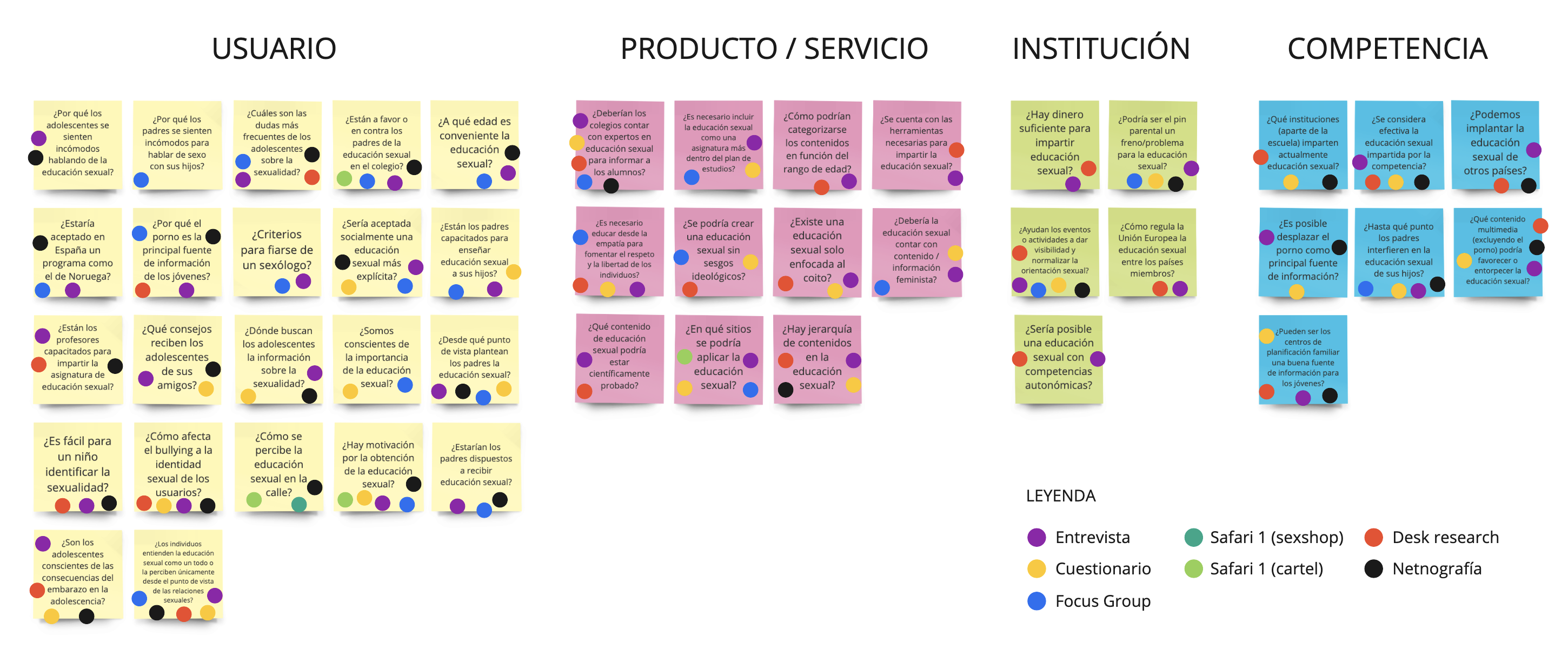
In order to empathize with users, we have started with exhaustive research. We have begun by formulating a large number of Research Questions that we clustered on the affinity map according to their involvement with the User, Product or Service, Institution and Competition.
To make the decision about which quantitative or qualitative research techniques we were going to use to answer our questions, we have assigned a color to each technique and we have assigned the stickers to each question.
There is no law that requires the introduction of sex education. Neither Spanish nor European.
We started with Desk Research and Netnography to collect a large amount of data on the subject and soak ourselves in knowledge. In this way we would be prepared to later formulate the questions for the Questionnaires and Interviews.
Desk Research and Netnography highlights:
- There is no law that requires the introduction of sex education, neither Spanish nor European.
- Sexual education is currently insufficient, it is ideological and focused on intercourse (penis-vagina relationship).
- In other countries like Norway, which are more advanced in the subject of sex education, they have a very explicit education program.
- Opinions on social networks are disparate, on the one hand there are parents who think that current sex education is insufficient, on the other hand there are users who think that too much is said about it and that it can be harmful to their children.
“[…] I find it more interesting to teach that there is a certain diversity of behaviors within erotics and to make clear what cannot be done, rather than teaching how to do it.”
The interviews gave us the expert point of view.
We have interviewed two expert sexologists, Alberto Álamo, emotional sexologist and psychologist, and José Luis García, clinical psychologist and sexologist.
They helped us to better understand the current situation of sex education in Spain.
Some quotes from the interviews:
“I consider that it has to be taught from preschool education. Absolutely yes. Preschool, primary and secondary education.”
“Sex Education in Spain is too politicized, ideologized and that professional approach is lacking, we cannot leave this to the politicians, because we won’t go forward.”
“[…] if the students don’t find the information in the classroom, they will go to look for it in the vast majority of cases on the internet and pornography, and then they will apply what they see in their relationships.”
“[…] they gave me a single talk at the secondary school and the talk basically consisted of how to put on a condom […] So the feeling that we had was "careful when fucking and we will put on the condom”.”
“Just because a boy knows what a condom is, it doesn’t mean that he is going to buy one and use it at the right time. That requires an education, a specific training.”
We have carried out 2 questionnaires, one for parents and one for adolescents. The highlight of the questionnaires is that:
Adolescents
30%
have not received sexual education
81%
are interested in receiving sex education
Parents
62,5%
believes that sex education in Spain is insufficient
62%
believe that sex education should be a compulsory subject
78%
did not receive sex education at school
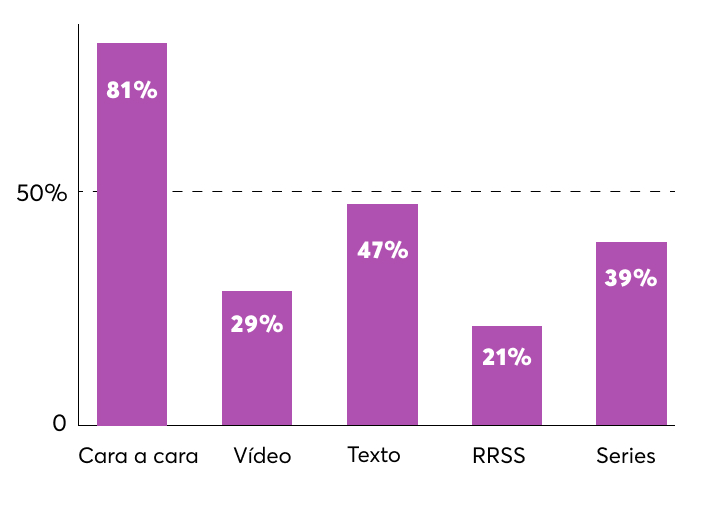
The responses of adolescents about the way in which they prefer to receive information were very different.
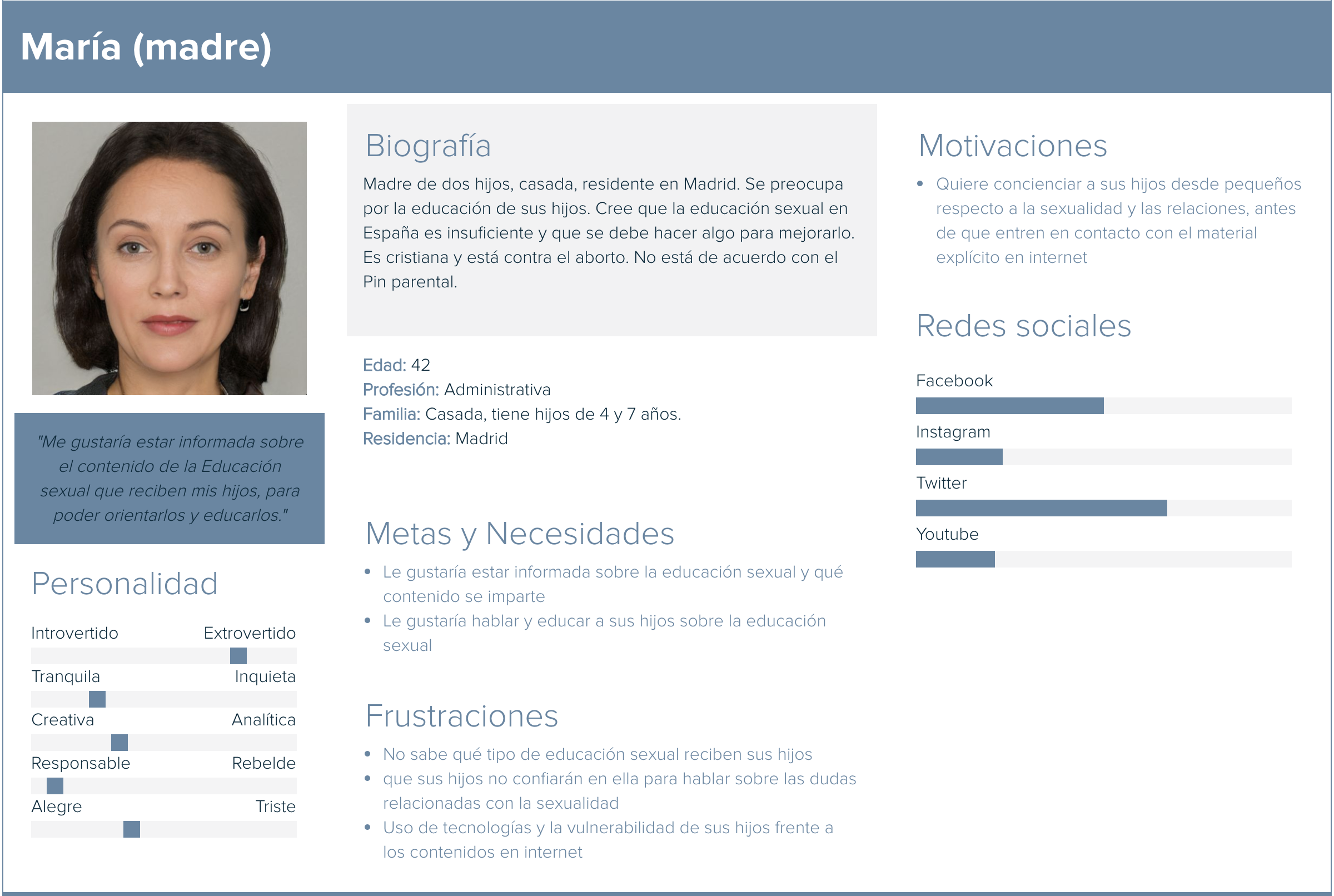
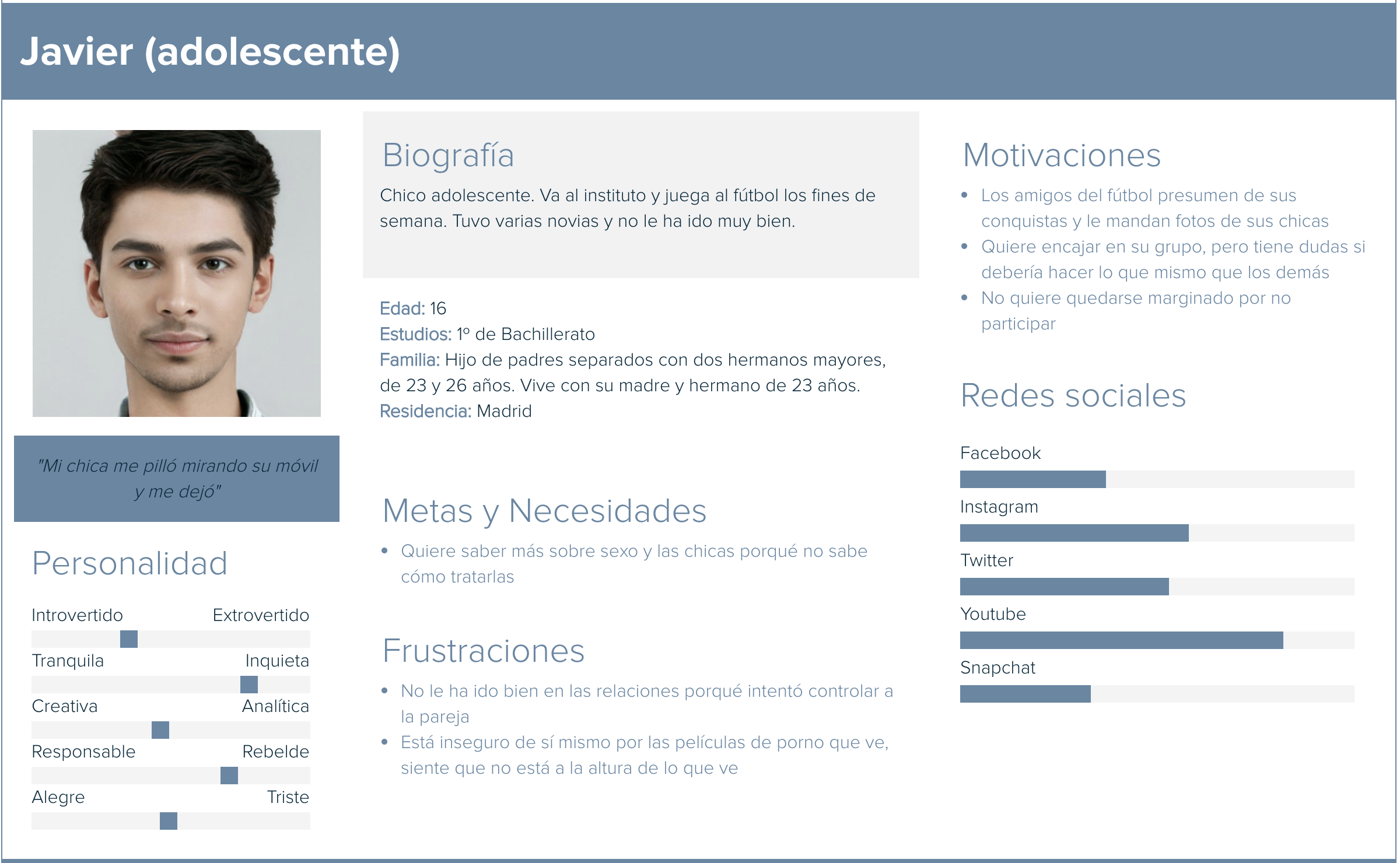
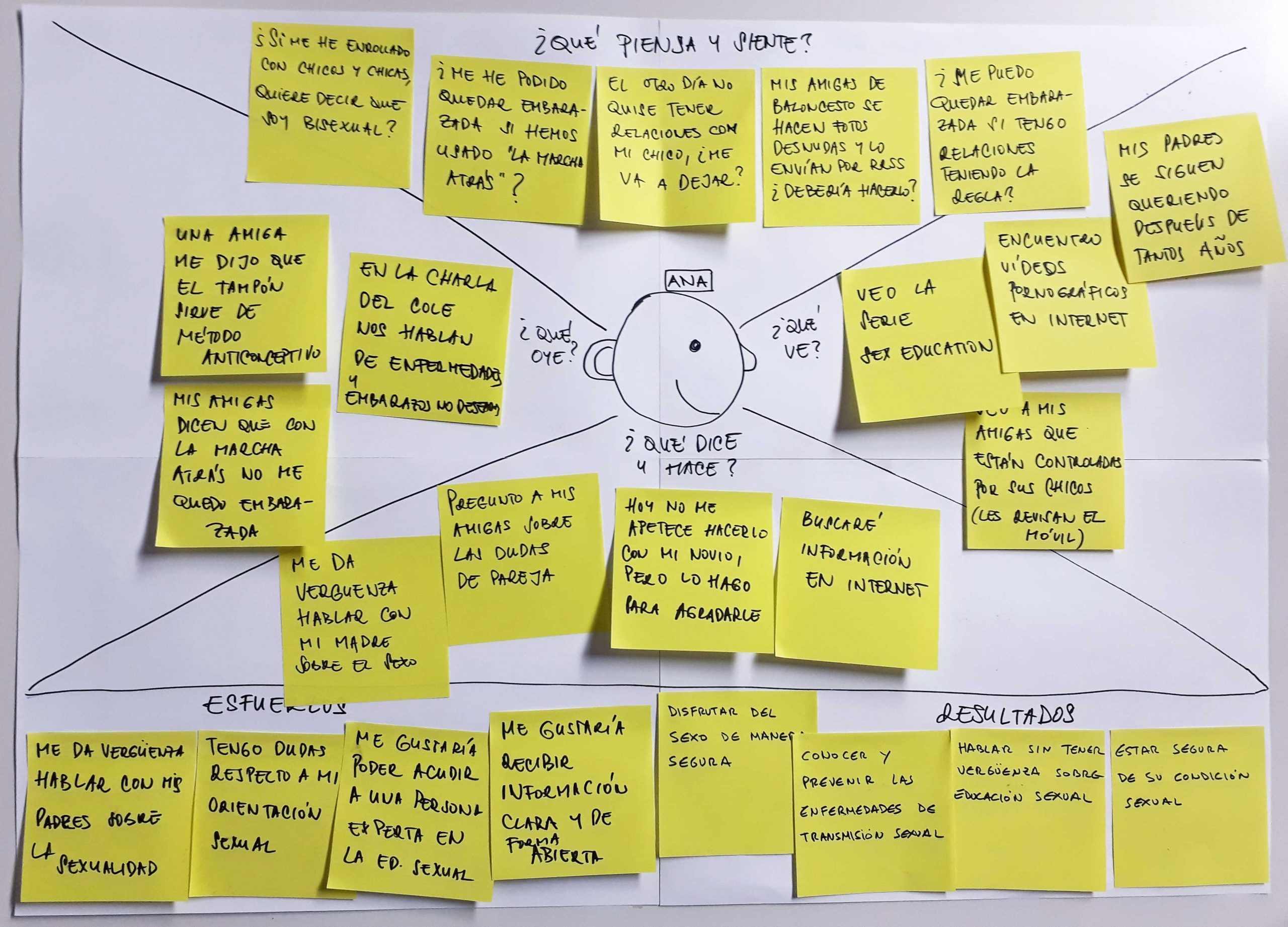
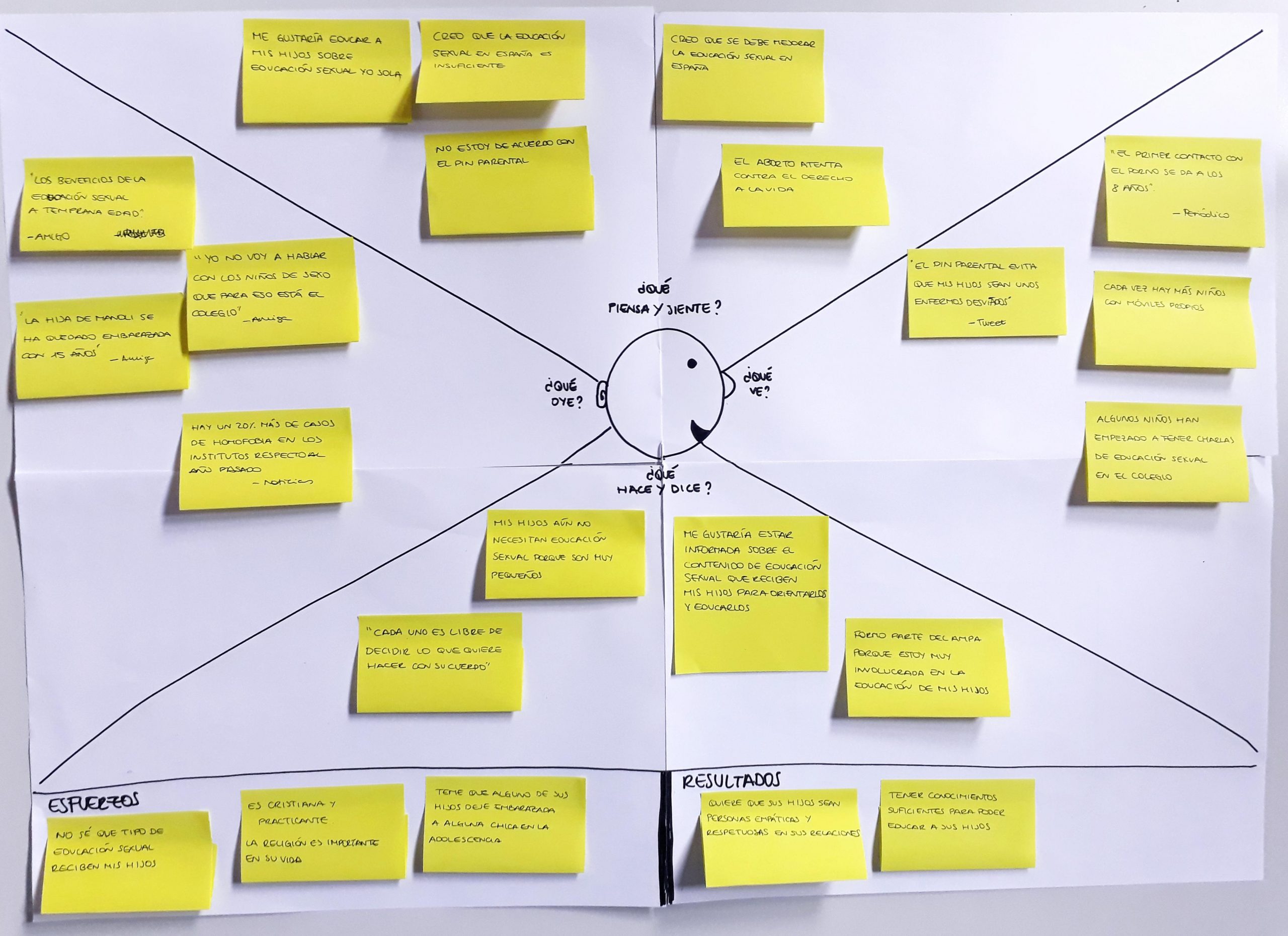
From the information collected in the research, we were able to create 4 user personas. Two corresponding to parents and two to represent adolescents.
- Father of a 15-year-old daughter concerned about the current situation of sex education in Spain
- He feels uncomfortable talking to his daughter about issues related to sex education
- He doesn’t know how to approach the topic because his parents never spoke to him and he doesn’t know the course syllabus
- He wants to protect his daughter’s health through quality sex education at school
- She believes that sex education in Spain is insufficient and that something must be done to improve it.
- She would like to be informed about sex education and what kind of content is taught and talk to her children
- She is concerned that she doesn’t know what type of sex education her children receive, that her children will not trust her to talk about the doubts related to sexuality and about the vulnerability of her children to Internet content
- She wants to educate her children about sexuality and relationships from a young age, before they come into contact with explicit material on the internet
- She has a boyfriend and has many doubts about love, sexuality and relationships
- She would like to have the possibility to speak to an expert in sex education
- She is ashamed to talk to her parents about sexuality
- She has questions regarding her sexual orientation
- After having relationships with her boyfriend, she has doubts about the possible consequences
- He wants to know more about sex and girls because he doesn’t know how to treat them
- His relationships have failed because he tried to control his couples
- He is not self confident because of the porn movies he watches, he feels that he doesn’t measure up to what he sees
- Soccer friends show off their conquests and send photos of their girls
- He wants to fit into his group, but he has doubts if he should do the same as the others
- Father of a 15-year-old daughter concerned about the current situation of sex education in Spain
- He feels uncomfortable talking to his daughter about issues related to sex education
- He doesn’t know how to approach the topic because his parents never spoke to him and he doesn’t know the course syllabus
- He wants to protect his daughter’s health through quality sex education at school
- She believes that sex education in Spain is insufficient and that something must be done to improve it.
- She would like to be informed about sex education and what kind of content is taught and talk to her children about sex education
- She is concerned that she doesn’t know what type of sex education her children receive, that her children will not trust her to talk about the doubts related to sexuality and about the vulnerability of her children to Internet content
- She wants to educate her children about sexuality and relationships from a young age, before they come into contact with explicit material on the internet
- She has a boyfriend and has many doubts about love, sexuality and relationships
- She would like to have the possibility to speak to an expert in sex education
- She is ashamed to talk to her parents about sexuality
- She has questions regarding her sexual orientation
- After having relationships with her boyfriend, she has doubts about the possible consequences
- He wants to know more about sex and girls because he doesn’t know how to treat them
- His relationships have failed because he tried to control his couples
- He is not self confident because of the porn movies he watches, he feels that he doesn’t measure up to what he sees
- Soccer friends show off their conquests and send photos of their girls
- He wants to fit into his group, but he has doubts if he should do the same as the others
70% of parents would like to educate their children about sex.
However, only 10% of teens are comfortable talking to their parents about this.
Findings and Insights
- There were several educational initiatives and programs implemented in different provinces, but the result is always the same: they disappear with each change of government.
- Sexual education is not compulsory in educational centers and, in the case it is taught, it is at the discretion of the teacher.
- We found interesting the fact that 70% of the interviewed parents would be willing to receive training on sex education in order to educate their children. However, only 10% of teens are comfortable talking to their parents.
After analyzing the results of our research, we set the following goal:
To provide adolescents and their parents with a unique Sexual Education model that guarantees quality training and fosters a relationship of trust between the two.
With the goal clear, we have begun to generate ideas to achieve it. Between the four of us we have achieved a considerable amount of ideas. Next, we have evaluated which ideas would have the best acceptance and bring us closer to achieving our goal, using a prioritization matrix. Finally we have voted with stickers.
The winning idea was an educational program:
An educational program, promoted from schools, that joins parents and children together, so that they learn together in confidence.
The program is based on an app as the main learning tool, a website as a support and a promotional bus with activities.
An educational program, promoted from schools, that joins parents and children, so that they learn together in confidence.
The educational program is made up of 3 parts:
- an App as the main learning tool
- a website with additional information as a support
- a bus with activities to promote the program
Schools provide access codes to the app and support learning in tutoring classes.
Depending on the code, you can enter one of the 3 existing profiles, Juniors, Parents and Teachers. In turn, in the Junior’s profile, depending on the code, you can access the appropriate content for each age range.
On the web you can download the application by entering the access code. It also provides additional information on the program, activities and events, and the bus tour schedule.
The promotional buses drive through all the provinces and carry out activities between students and parents.
Children can progress in learning on their own. Parents are relaxed because from their interface they can see what kind of content is being taught and they can keep an eye on the progress of their child.
The word Ellis could be used in Spanish as an inclusive term.
Naming
To choose the name for the program we have looked for inspiration in the concepts related to sex education. After several ideas we decided on the name Ellis.
It comes from the name of a British sexologist, Dr. Haverlock Ellis considered the first sexologist in history. The word Ellis is short and easy to remember. What we found interesting is that in Spanish it could be used as an inclusive term, since it does not fall into gender inequalities.
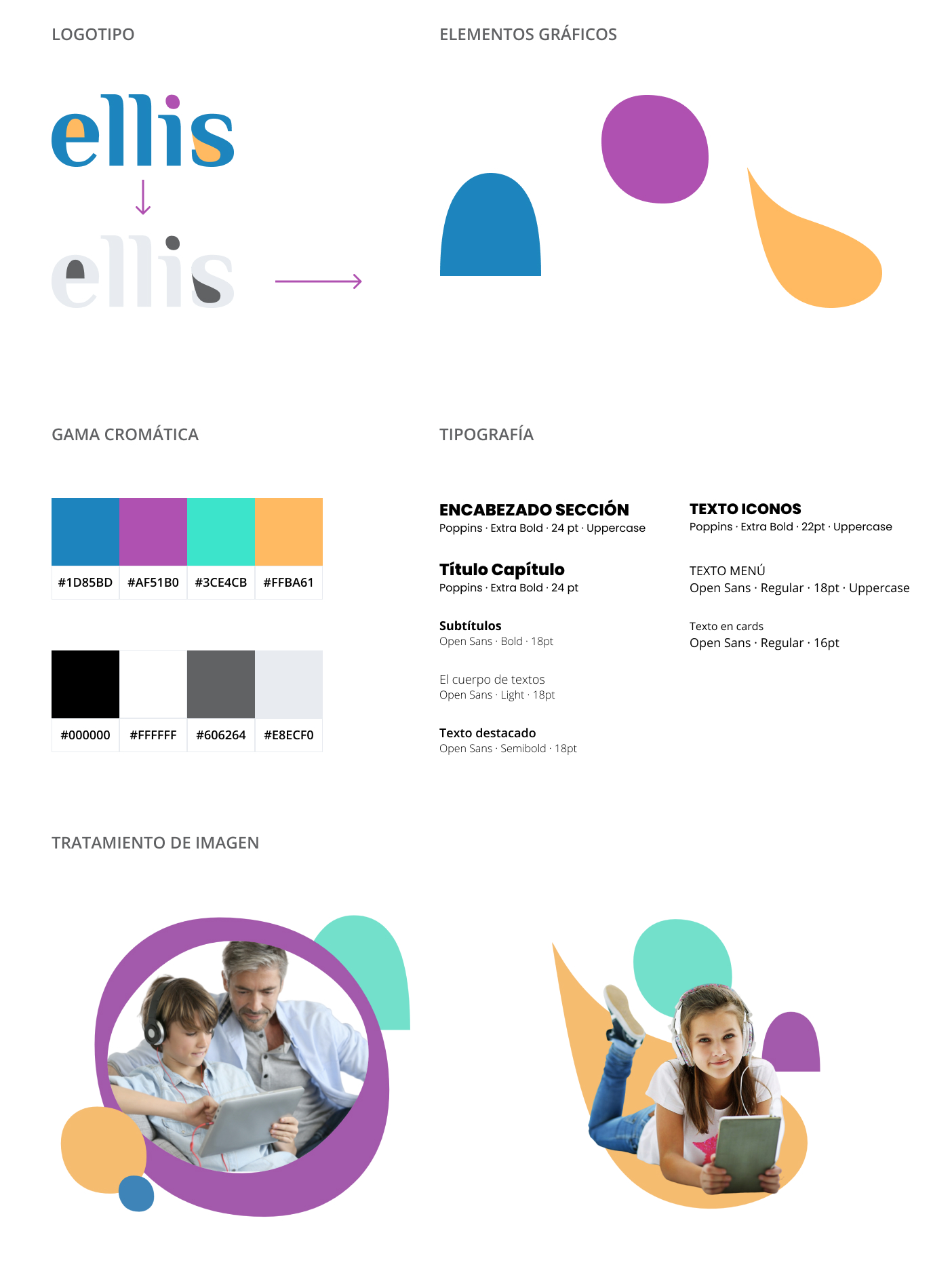
Logo
To design the logo, we took into account that it will have to be displayed on different format, both online, app and web, and offline, bus signs. We have decided for a typographic logo and we have created some graphic elements from the negative spaces of the letters to use as visual resources.
Based on the results of our research and the benchmarking carried out, we have made decisions about what kind of content should be included in the program.
Apart from the course contents, there would be a Questions section, where both children and parents could search for answers. There would be a Glossary of the terms related to sexual education and a Directory, so that users can seek help in the case of abuse, bullying, doubts about pregnancies or other sensitive issues. We also include a section on the program Activities, to check events and schedules of the promotional bus.
The app consists of 3 interfaces: Junior, Parents and Teachers.
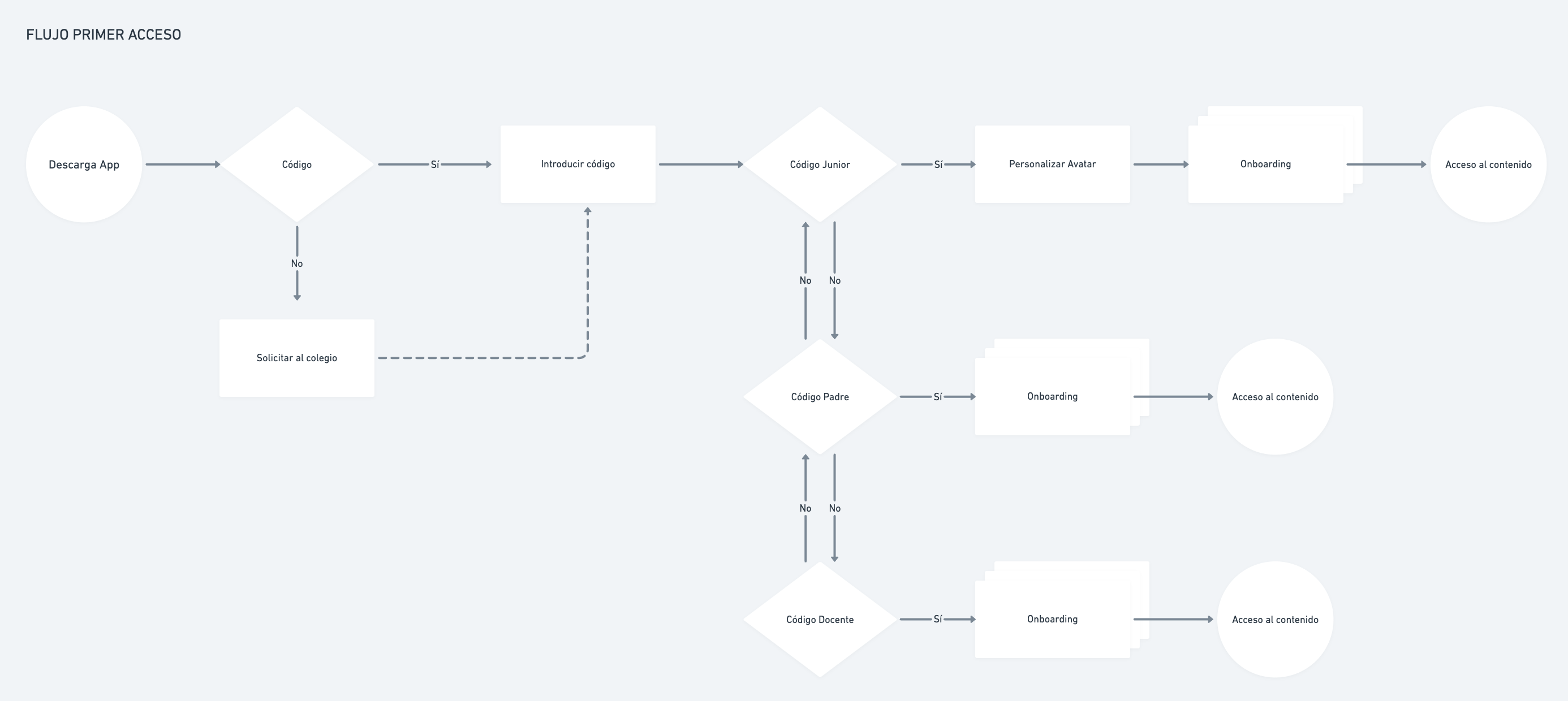
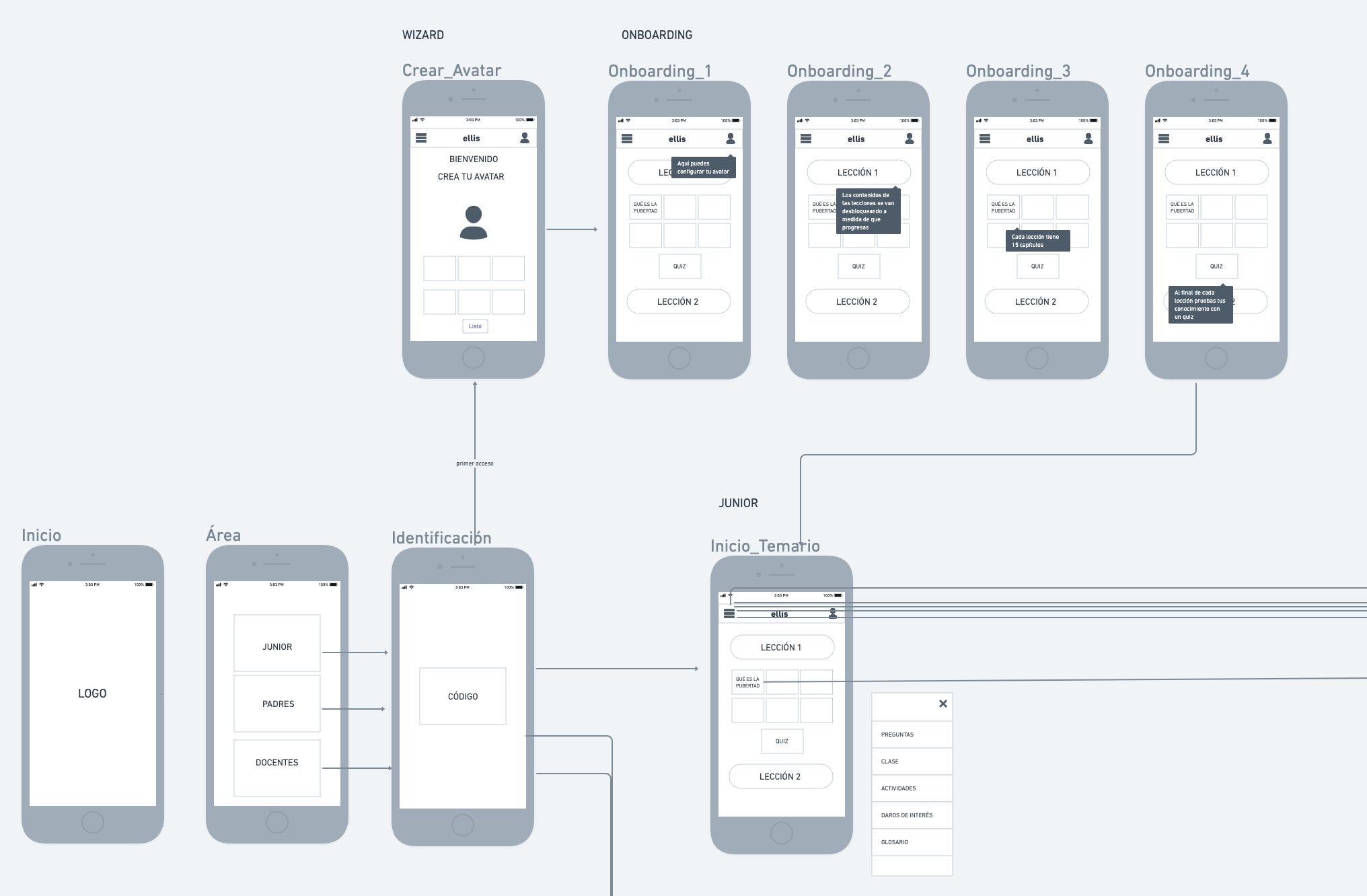
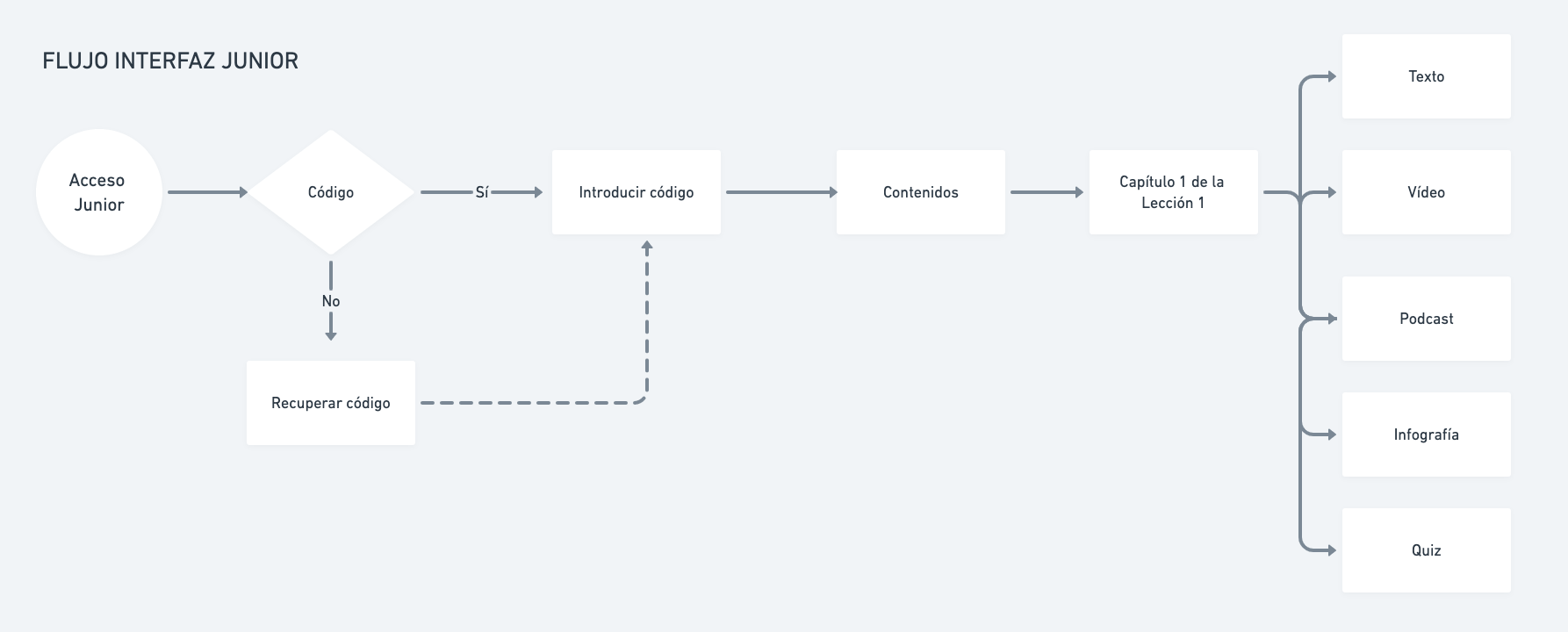
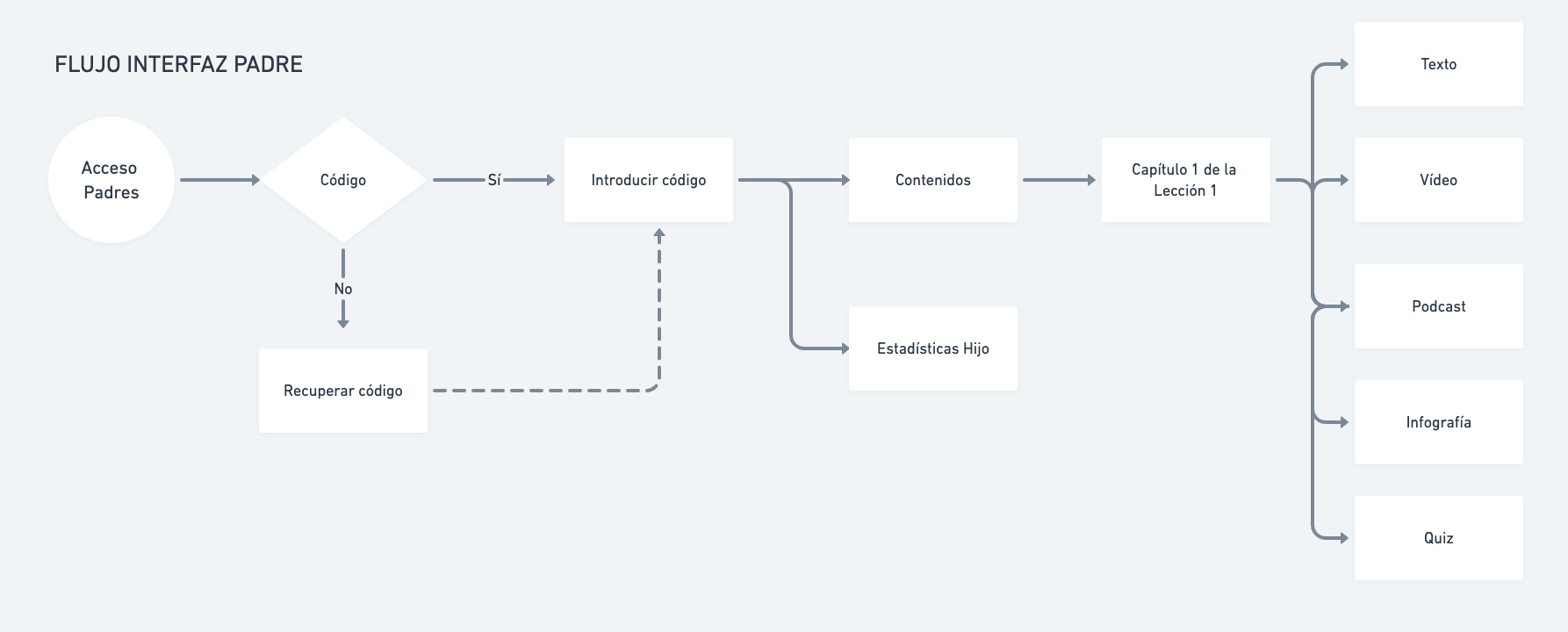
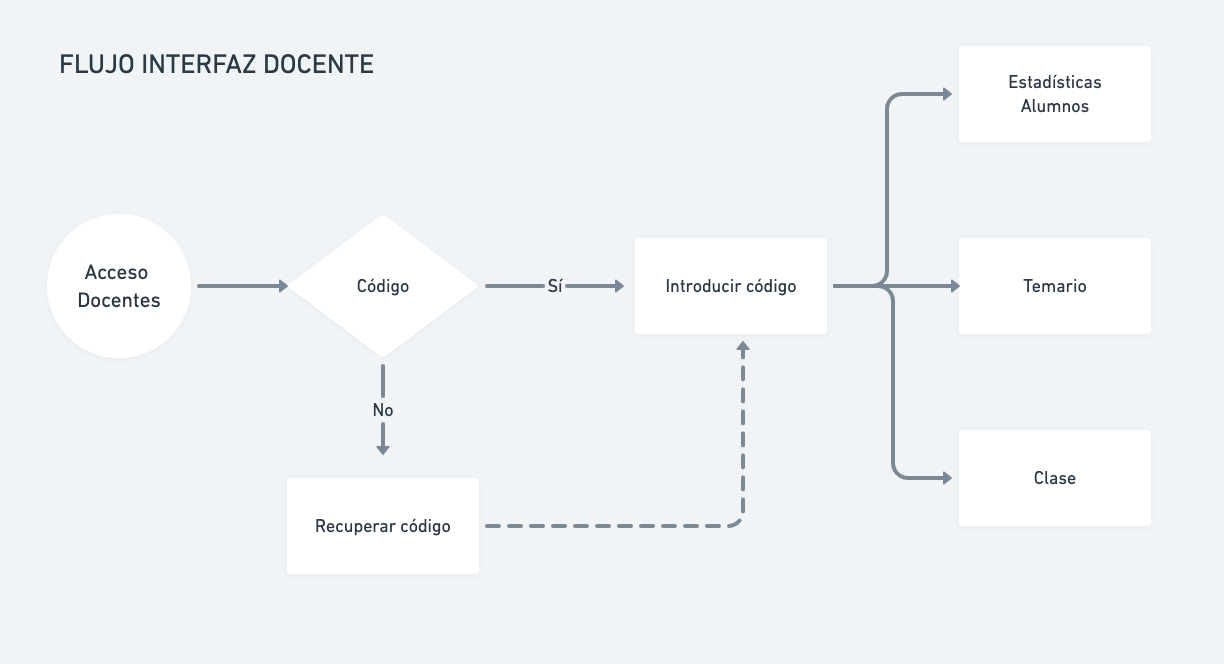
We have started the design drawing the flowcharts.
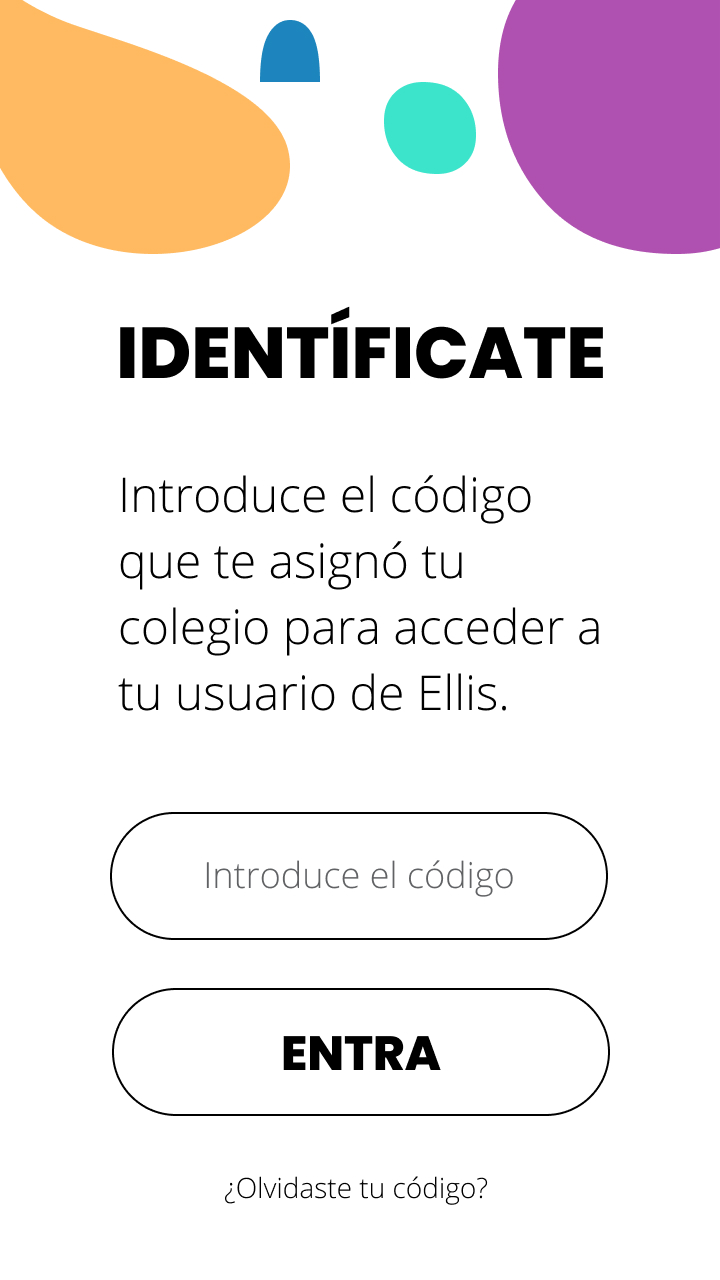
After downloading the app, you must enter the access code provided by the school. According to the code, the user enters the interface of the student, parent or teacher. Students access content according to their age.
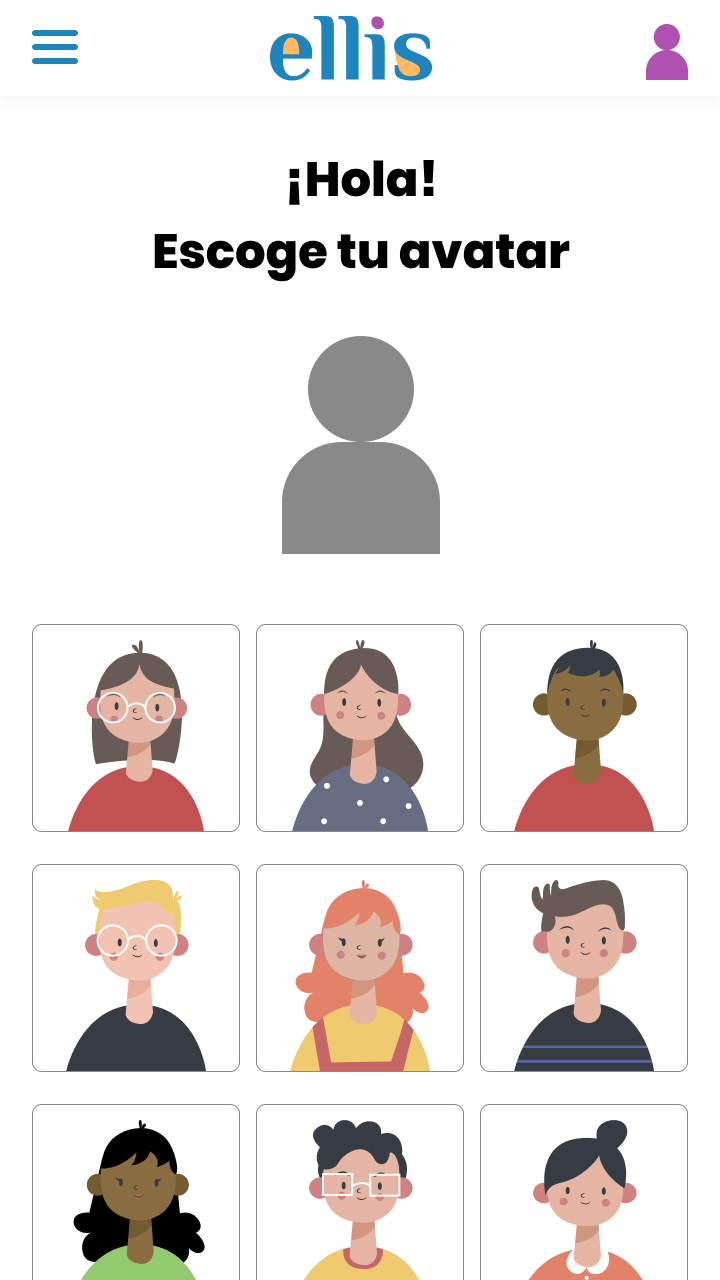
Students can customize their avatar, follow a short onboading to explain the use of the app and then the start screen is shown, where all the lessons appear.
Junior Interface
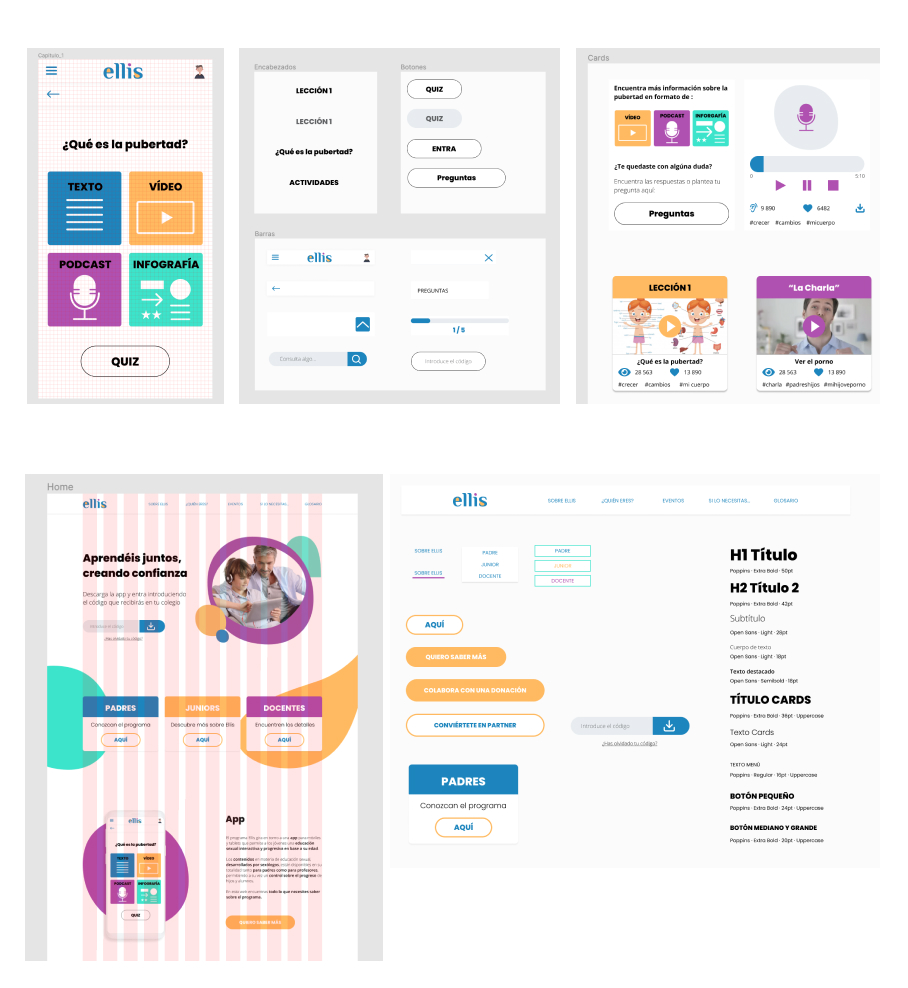
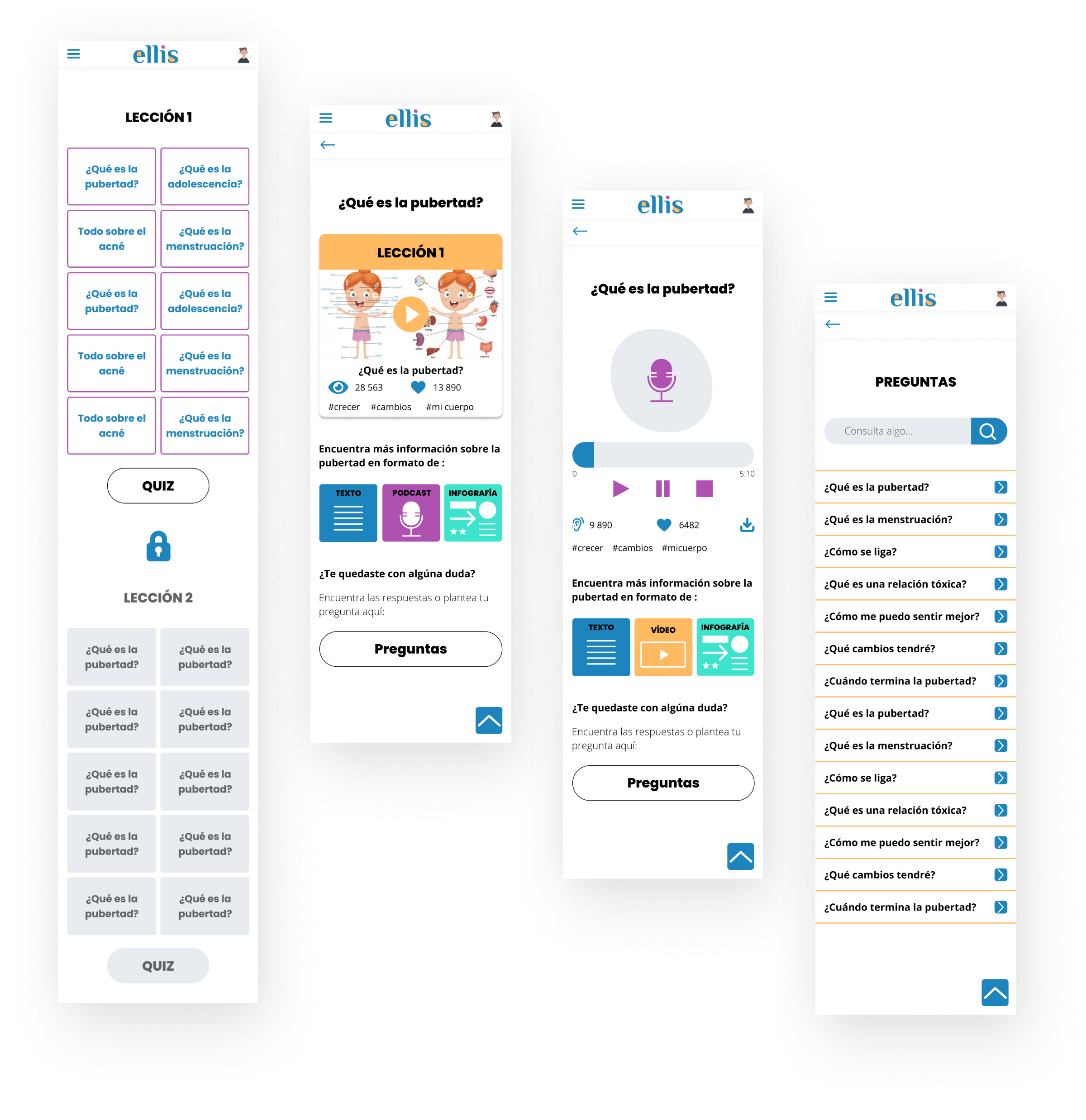
Available lessons are displayed on the home screen. Each lesson consists of 10 sections that are unlocked as the student progresses.
At the end of each section there is a short quiz with 5 questions. When the student completes the 10 sections of a lesson, it is necessary to complete a quiz of 10 questions to unlock the next lesson.
The titles of the blocked lessons are visible, so if there is a topic that the students find particularly interesting, it motivates them to go through the lessons in order to reach this topic.
There are 4 different ways to receive information:
- Reading an article
- Watching a video
- Listening to a podcast
- Viewing the content as an infographic
We made this decision as a result of our research, where the preferences of adolescents for the way they receive information were very different. In this way, each student can choose the most comfortable way to consume the content.
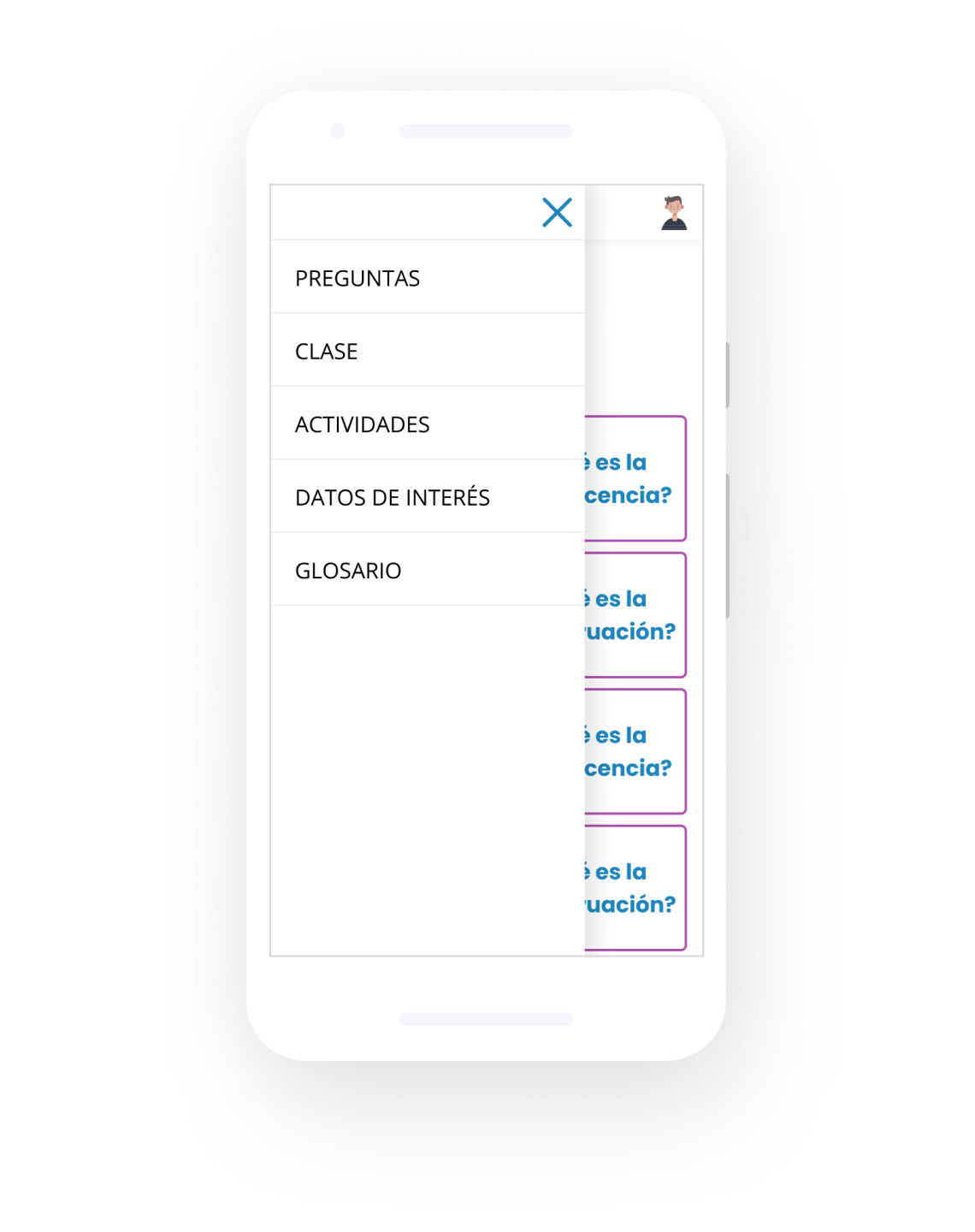
From the menu you can access sections that are common to the 3 profiles:
- Questions, where you can clear up any doubts
- Activities, with information on Ellis Bus events and schedules
- Directory, where you can find emergency numbers
- Glossary of terms related to sex education
Parents Interface
The parents interface starts from the course content screen, just like the juniors one. The difference is that all the lessons are unlocked. So they can see all the contents anytime and be prepared if the child has a question.
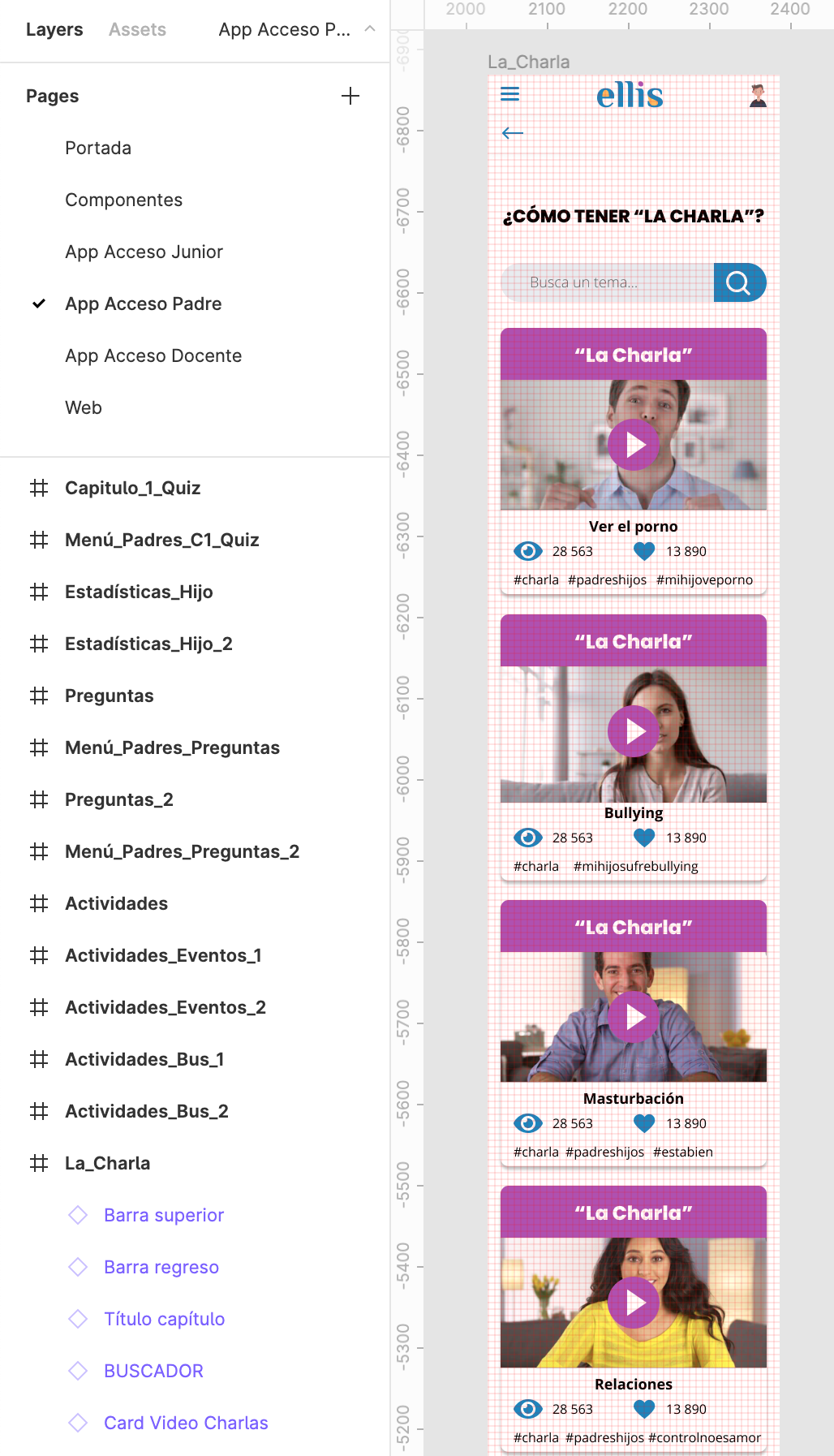
Parents have 2 additional sections:
- How to have “The Chat”, with videos from sexologists who give advice about how to deal with sensitive issues with their children
- Statistics, in which they can see the progress of their children, what lessons they have passed, quiz results and the questions they have searched.
Teachers Interface
The teachers interface is simpler, apart from accessing the common sections from the menu, they have the following functionalities:
- Syllabus, to access the different lessons according to the age ranges of the students
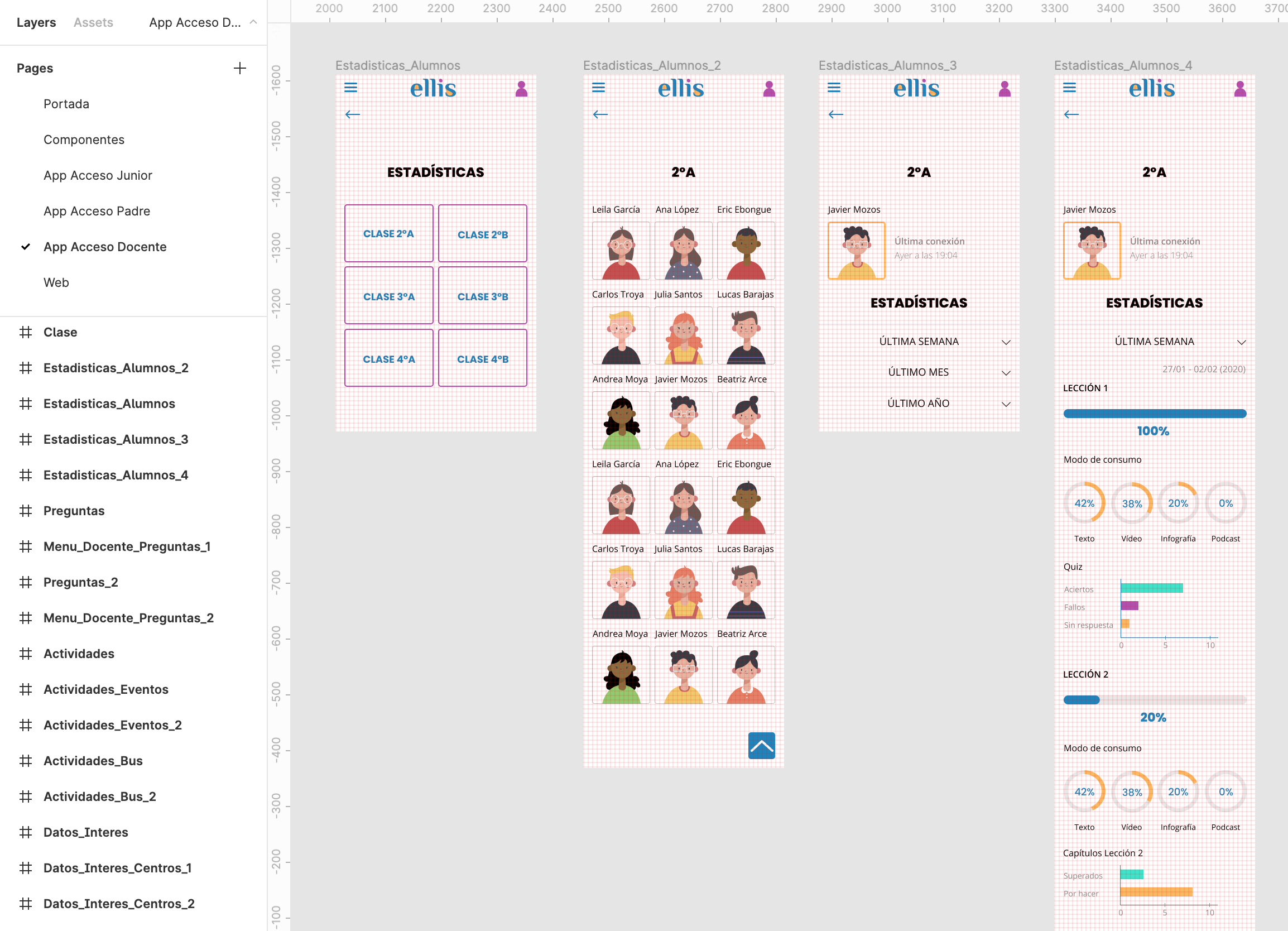
- Class, where they can create a class and generate the access code
- Statistics, to see the progress of all students
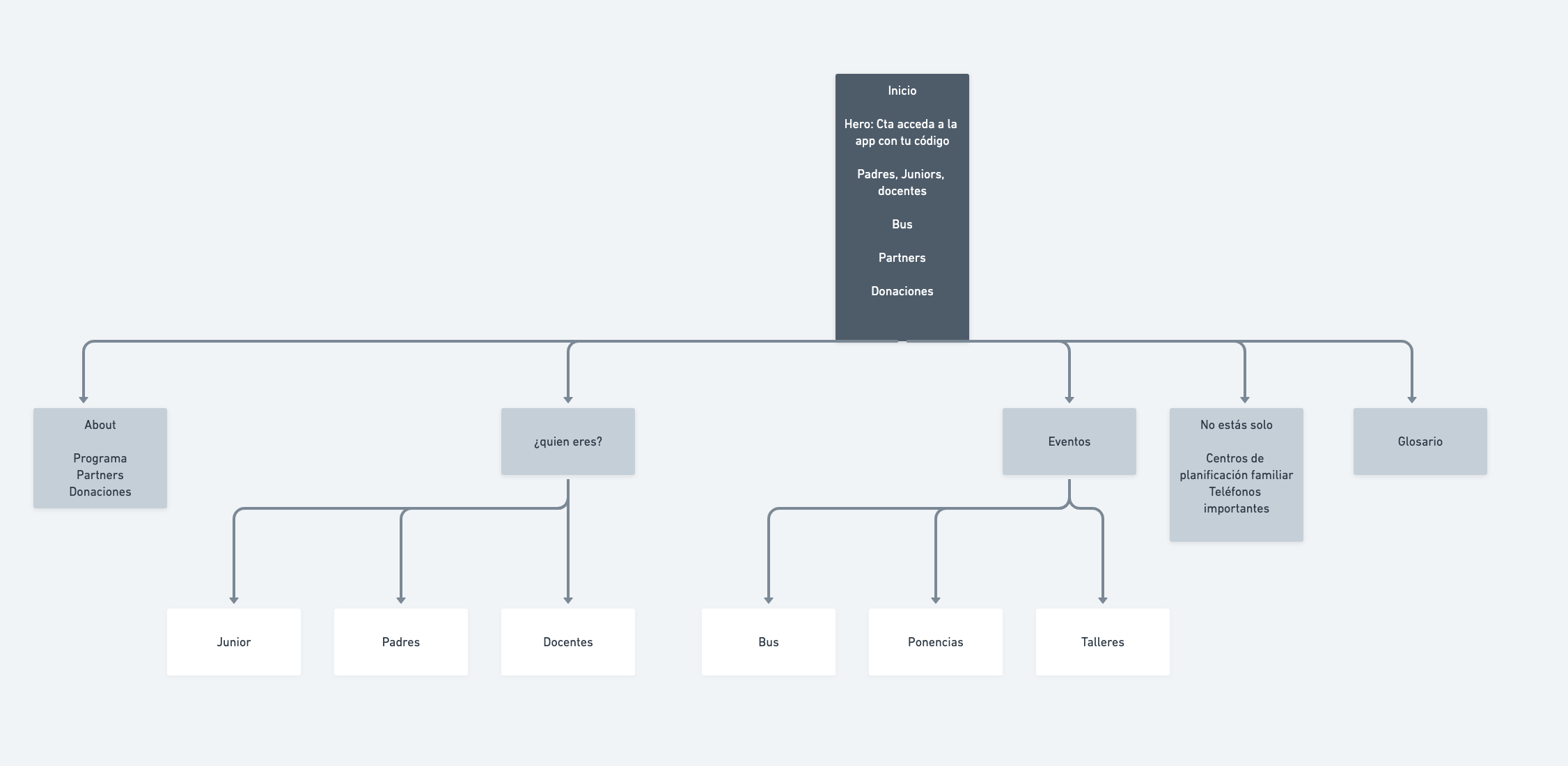
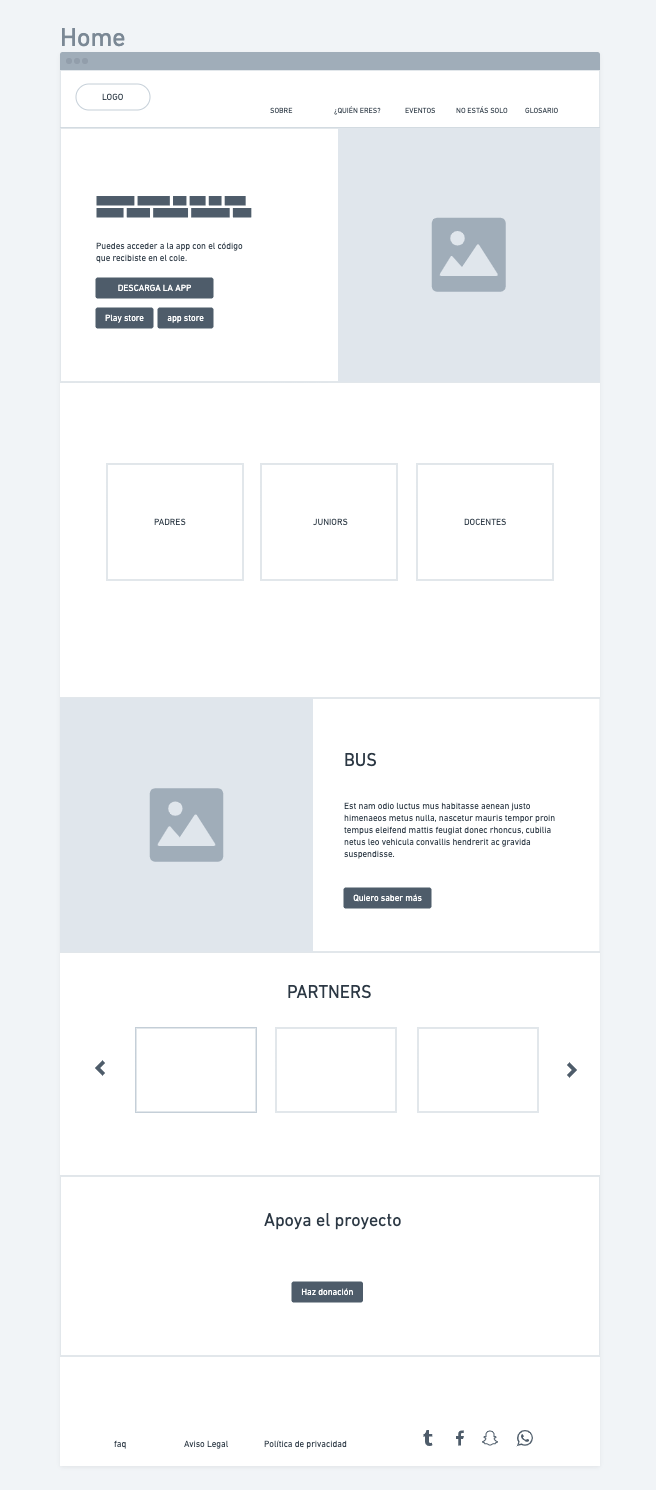
The website provides additional information about the educational program and activities.
We have created the site information architecture and the home page wireframe.
The prototype of the home page has a width of 1140px, it is designed using the 12 column grid with gutter of 30px and margins of 15px.
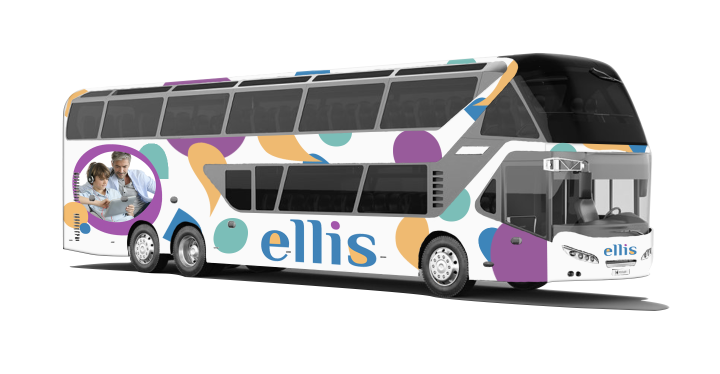
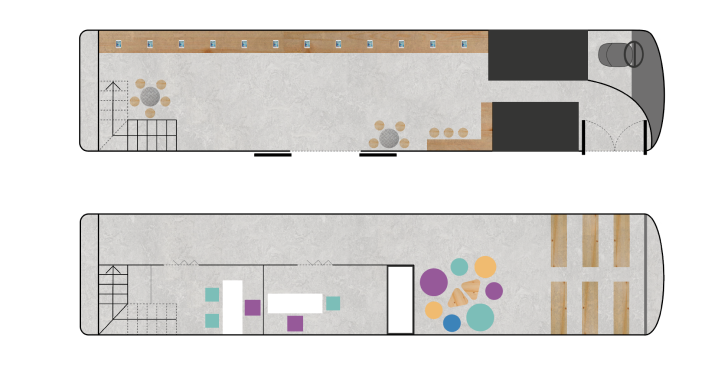
We have devised a fleet of buses with a redesigned space as a support of the program.
The buses will go across each province of the country, offering sex education talks by a professional team of expert sexologists.
The bus has an STD examination and detention space. There is a place to screen educational and documentary videos, and a help team teaches you how to use the app on mobile phones and tablets. Interactive activities and the Ellis Quiz will be held between students and parents.
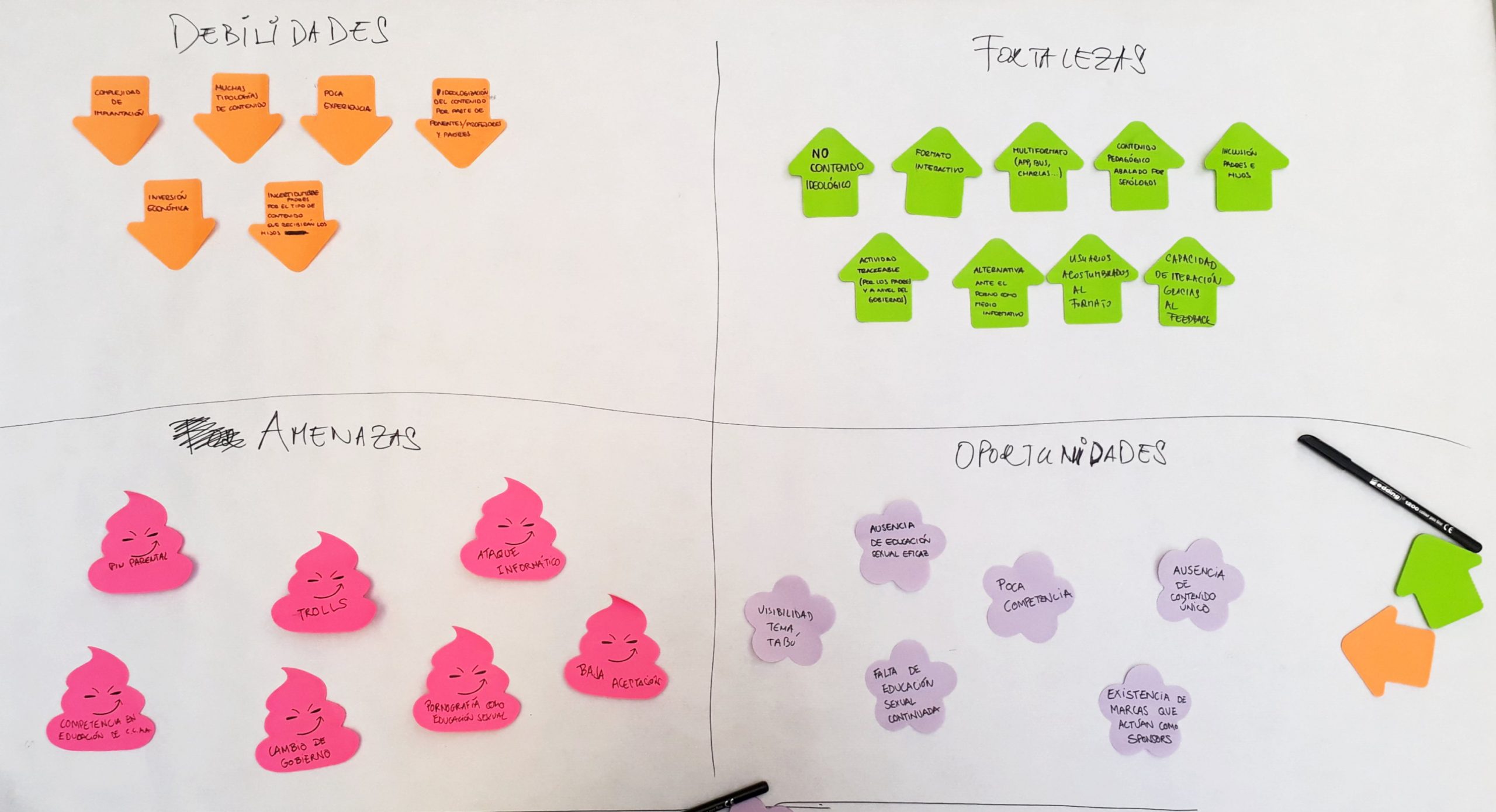
Our purpose was to find a solution that doesn’t disappear with the next change of government.
Sex education in Spain is a very complex issue and proposing and implementing any change or improvement that lasts is practically impossible.
We have devised the Ellis program with an app as its main tool, thinking that it will not disappear, it will continue to be available for use, even if it is no longer officially promoted from schools.
As future improvements, it remains to test the prototypes with the different user profiles in order to validate our idea and to detect opportunities to iterate the design.
Project learnings
Constrains are good
Team work