Approaching the problem of Emptied Spain with a disruptive idea

How we have thought up a digital sector school located in an abandoned town in Emptied Spain to bring technology and opportunities to rural areas.

Approaching the problem of Emptied Spain with a disruptive idea

How we have thought up a digital sector school located in an abandoned town in Emptied Spain to bring technology and opportunities to rural areas.

LEAN UX

Role

UX / UI designer

Team of 2 designers

Skills

Research | Idea prioritization | Proto Personas | MVP | Wireframes | Web design | Video edition | Seo 

Time

3 weeks

Tools

Paper | Gitbook | Miro | Figma | Viar 360 | WordPress | Elementor | Mailchimp | Google Analytics | Hotjar  

Role

UX / UI designer

Team of 2 designers

Skills

Research | Idea prioritization | Proto Personas | MVP | Wireframes | Web design | Video edition | Seo

Time

3 weeks

Tools

Paper | Gitbook | Miro | Figma | Viar 360 | WordPress | Elementor | Mailchimp | Google Analytics | Hotjar  

Web responsive - UnicornLab - proyecto Lean UX
THE PROBLEM

In Spain there are 3000 abandoned towns.

In rural Spain, job opportunities and services (in many cases even essential ones) are scarce. There is a lack of technological infrastructure, and the population is getting older.

These factors have caused rural depopulation. Out of the 8,131 municipalities in Spain, 5,002 have a population of less than 1,000 inhabitants. In Spain there are 3000 abandoned towns.

What can we improve in rural areas to stop their abandonment?

We have developed a project following the Lean UX methodology to fight against the rural depopulation in Spain, linking the Fintech sector and immersive technologies.

THE RESULT
We have devised a digital sector school with bootcamp courses

The idea is to buy an abandoned town and turn it into a school, where students will live together during the training, thus reinforcing the intensive feature of bootcamps and teambuilding.

In this way, we can bring technology and foster the economy of the surrounding towns, which would act as providers.

We have built a Landing Page as a MVP to validate the idea

We set goals and KPI’s and to be able to measure the results we have built a WordPress Landing Page and launched it.

We collected data for a week using Google Analytics and Hotjar and then analyzed it. We managed to generate interest and were able to detect opportunities for improvement.

THE PROCESS

How to relate immersive technologies, Fintech and Emptied Spain?

We started with research in order to learn about the issues that we had to address.

We carried out Desk research focusing on two objectives:

What has already been done?

Find out what projects have been launched to solve the problem of rural depopulation, both in Spain and in other countries. See what has worked and what has not, and where we can find our opportunity.

Immersive technologies.

Investigate the possibilities offered by different technologies, such as virtual reality, augmented reality or virtual assistants, to know what technology suits our project the best.

Changing our approach helped us to come up with a disruptive idea

We have started to investigate the issue of Emptied Spain, thinking of solutions that would make people want to stay in the rural areas. We were asking ourselves:

How to ensure that people don’t continue leaving the villages?

How to bring technology and promote the local economy so that people don’t leave?

We realized that this was a complex problem. We decided to give it a twist and think about:

How to make young people want to leave big cities?

We ended up formulating the following challenge:

Give empty towns a new life, making them attractive to young people from cities through new technologies, and thus create new opportunities for the inhabitants of nearby areas.

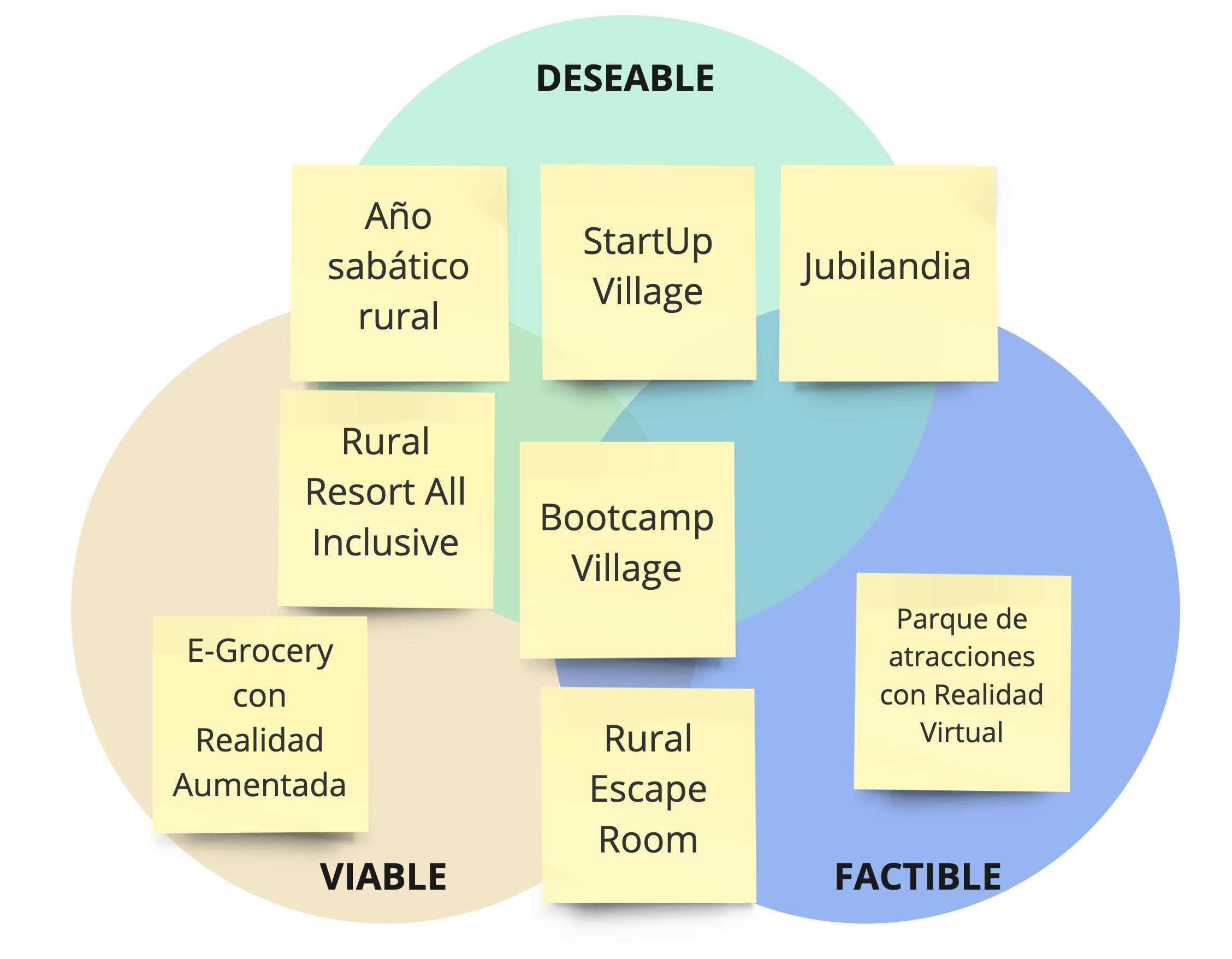
Looking for the most desirable, viable and feasible idea

We started to generate ideas about how to get people to leave the city. We created the following list of ideas:

  • Rural gap year
  • Rural Resort All Inclusive
  • E-Grocery with Augmented Reality
  • StartUp Village
  • Bootcamp Village
  • Rural Zombie Escape Room
  • Retiree-land
  • Theme park with Virtual Reality
Lean UX - Matriz de priorización
Matriz de priorización

Then we have prioritized our ideas through a matrix. The most desirable, viable and feasible idea turned out to be:

Bootcamp Village

The idea is to buy one of the abandoned towns and turn it into a school with bootcamp courses in the digital sector. The students would be housed in the town during the course, thus enhancing the intensity of the bootcamp training.

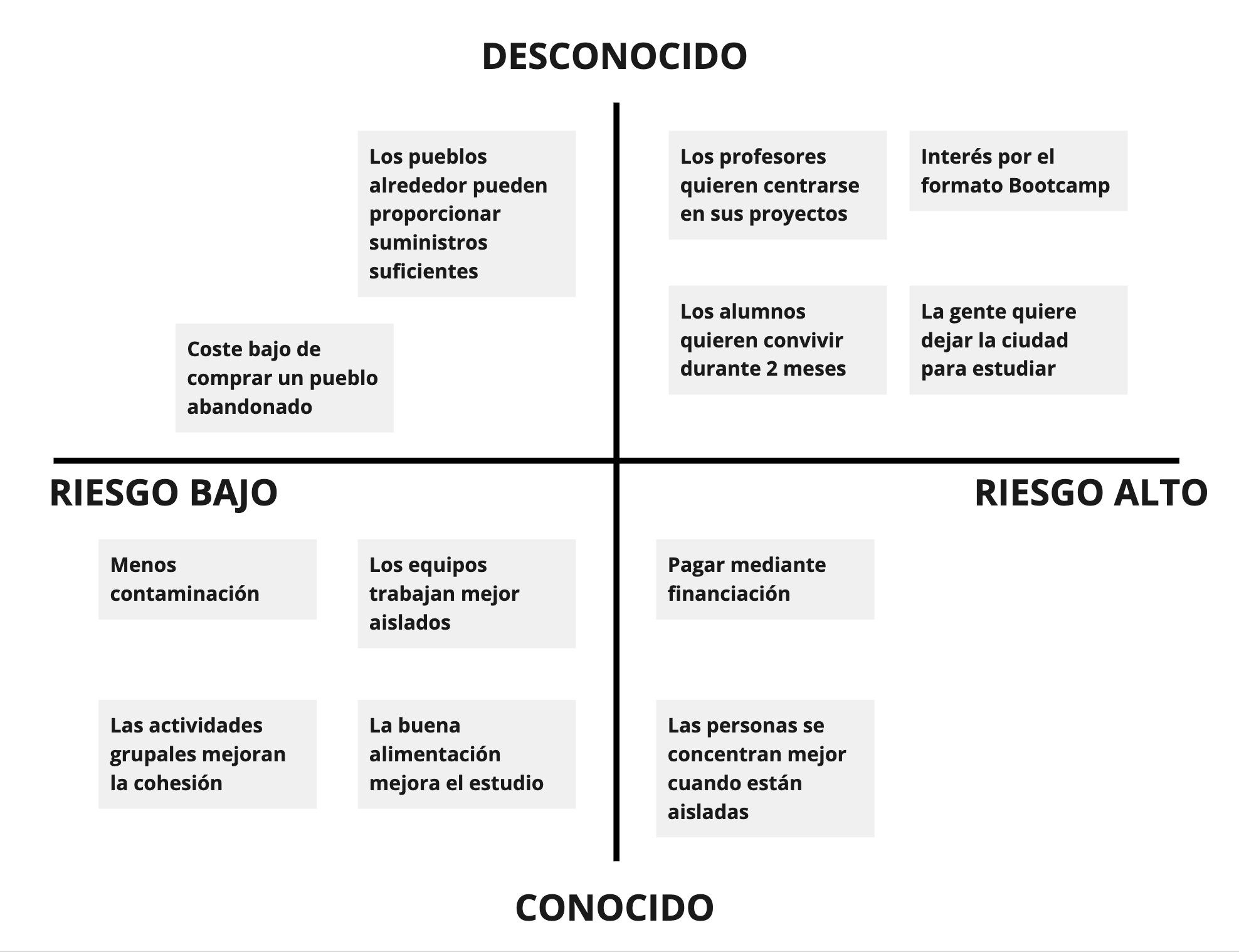
We have generated a series of business assumptions in order to identify the risks of the project.

To find out which of our assumptions are the riskiest, we prioritize them in the matrix, based on their level of risk and our knowledge of them.

Thanks to this prioritization we could find out which project assumptions we should test first, since we cannot test them all.

Lean UX - Priorización de supuestos
Matriz de priorización

The assumptions that are located in the high risk and the unknown quadrant are those that we have transformed into hypothesis statements to validate them.

We believe that by transforming a village into a Bootcamp School with accommodation for young people from the cities, we will...

[…] ensure that the surrounding towns have business opportunities as suppliers to the school.

We believe that by transforming a village into a Bootcamp School with accommodation for young people from the cities, we will make students focus more by being isolated from their everyday routine.

We believe that by transforming a village into a Bootcamp School with accommodation for young people from the cities, we will ensure that students and teachers live temporarily outside the city.

We believe that by transforming a village into a Bootcamp School with accommodation for young people from the cities, we will ensure that students and teachers live together during the course.

We believe that by transforming a village into a Bootcamp School with accommodation for young people from the cities, we will allow teachers to focus on their Side Projects by working intensive shifts

We will know that this is true when we verify that there is an interest in the school.

Taking into account the time constraints to collect the metrics, we established an objective to verify that there is an interest in the school in getting 50 visits to the web and that 15% of the visits become leads.

Lean UX - Protopersona estudiante

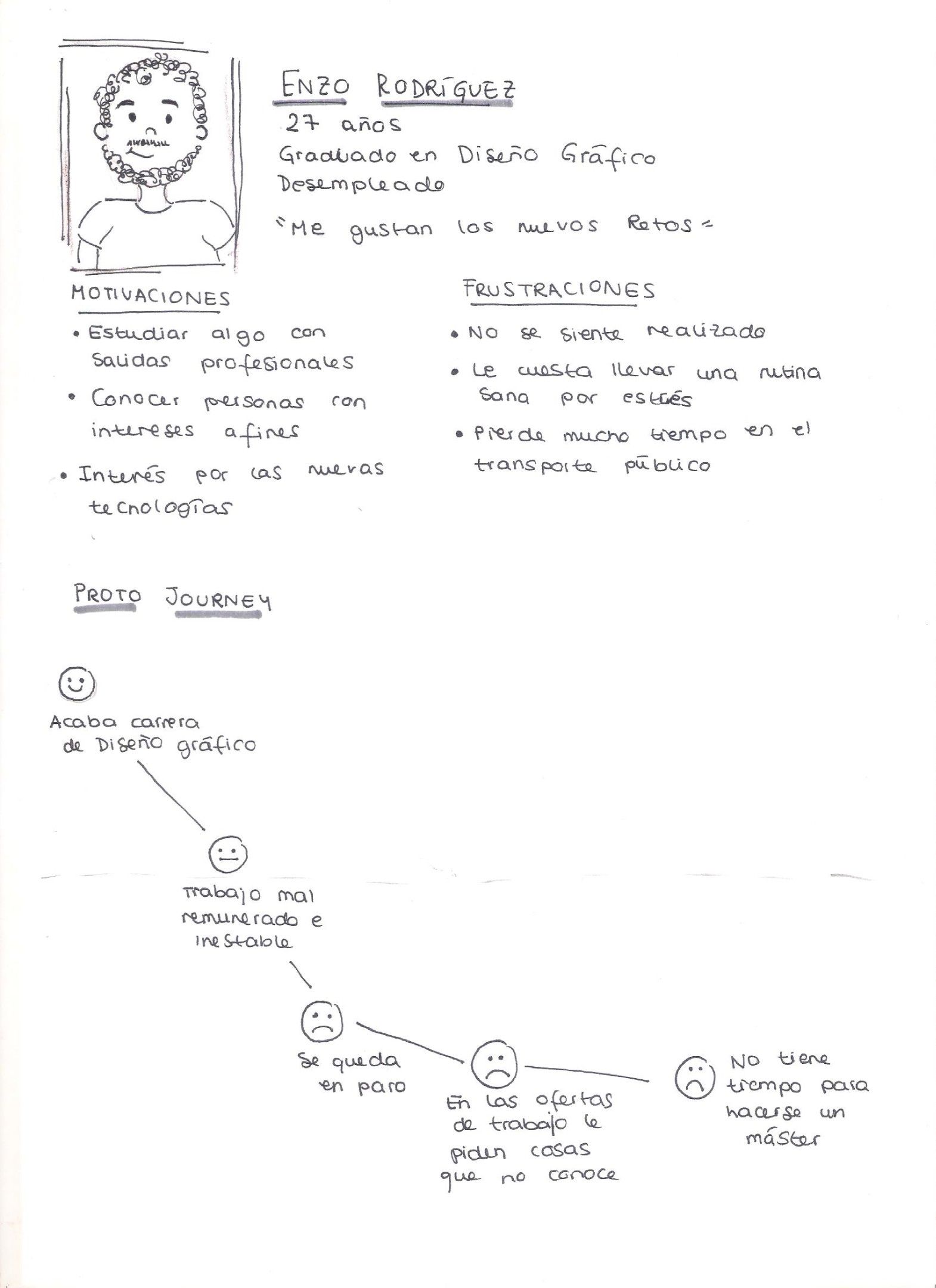
Enzo cannot find a career opportunity as a graphic designer and wants to study to improve his chances. He cannot spend one year on a Master’s degree, he is looking for a faster solution. He is concerned that stress and daily routines will make it difficult for him to adjust to the intensive training.

Lean UX - Protopersona profesora

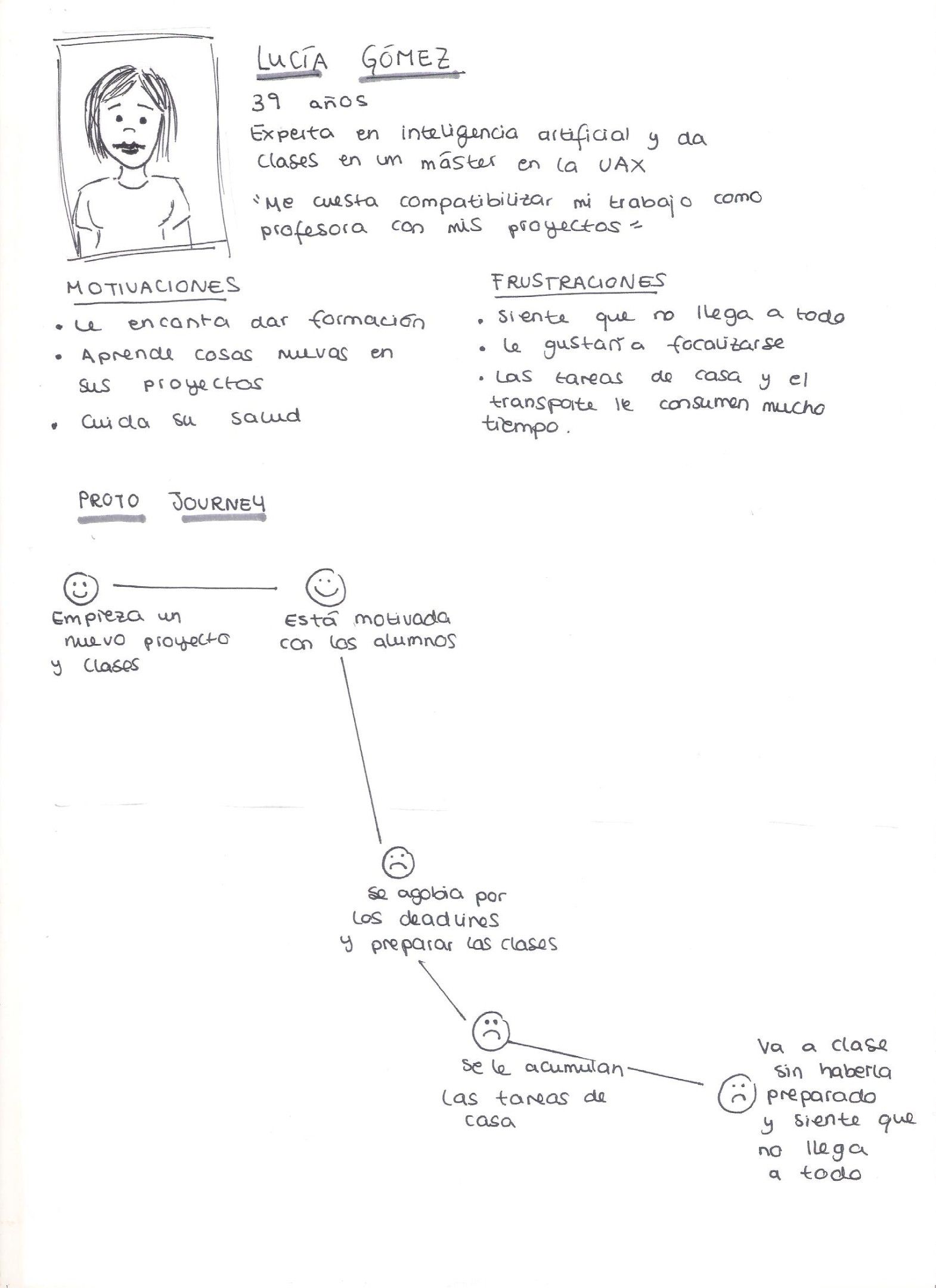
Lucia is a teacher, an expert in artificial intelligence. She wants to make her work compatible with her projects. It is difficult for her to find time and focus on her projects, as the household tasks and daily commuting are time consuming.

We created Proto Personas and Proto Journeys for the two profiles of our target audience.

Students who want to invest in intensive training and want to get away from the hustle and bustle of the city, stress and daily routines in order to be able to focus 100% on their studies

Teachers who are interested in teaching classes in the digital and technological sector and are looking for a way to optimize their time to focus on their personal projects.

Placing the problem in the center.

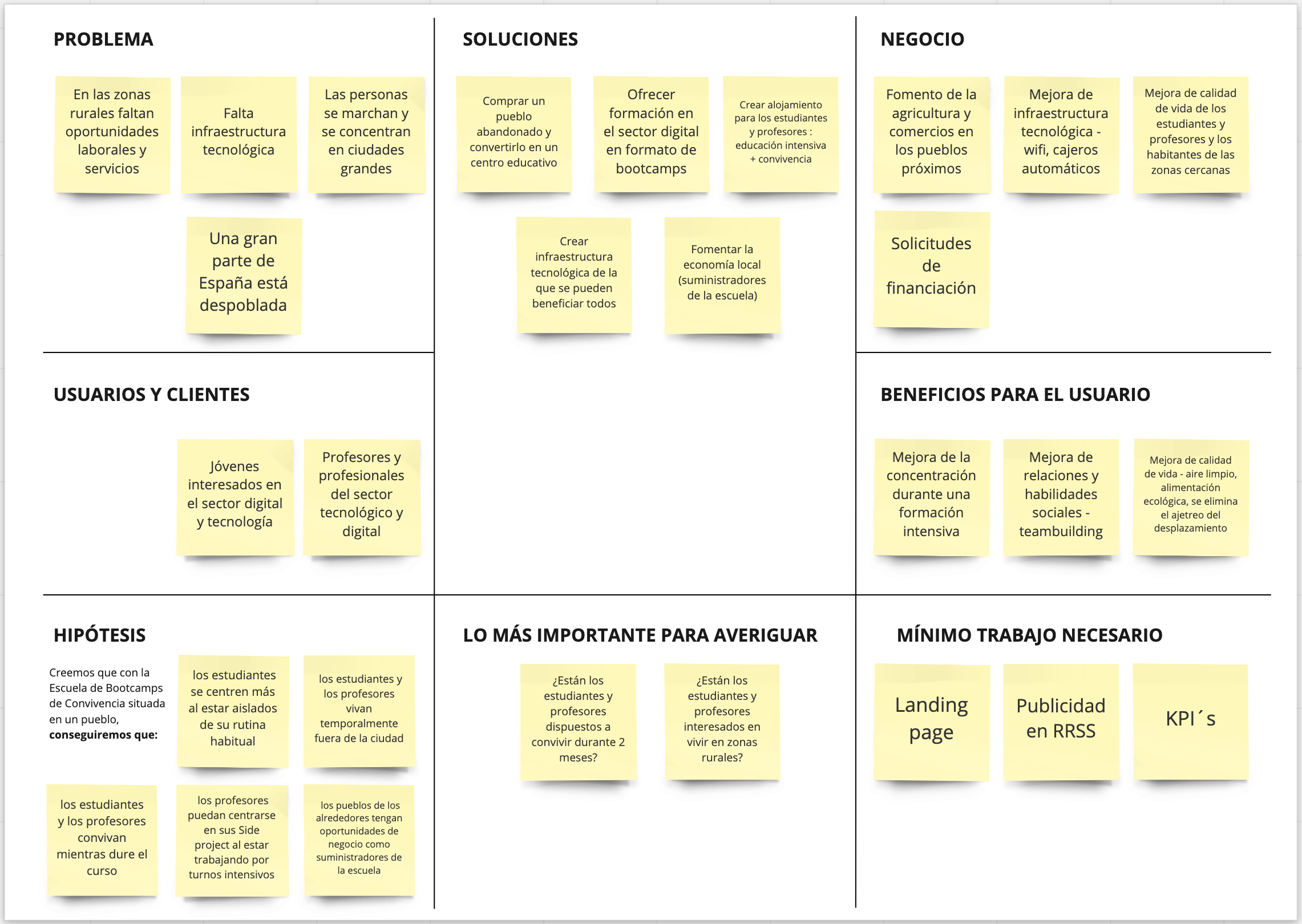
To help us visualize all the information in one place, we have created a Lean Canvas. This way, we can place in the center the problem to be solved and define the features necessary to build, measure and learn.

Lean Canvas
Lean Canvas

Once we know what results we want to achieve and which users we are targeting, we can start to think about what products, services or functionalities we have to develop to achieve these results.

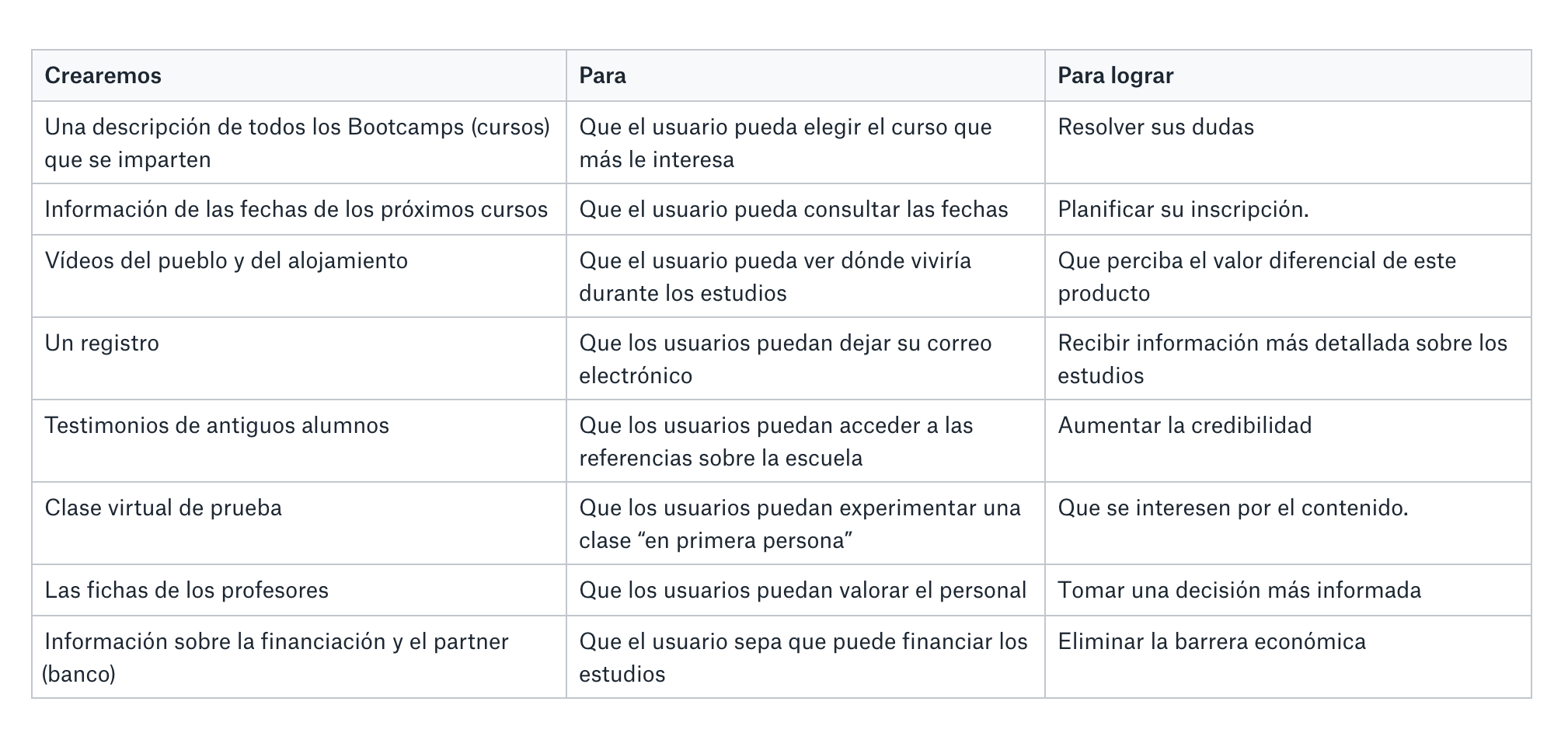
We have created a list of functionalities and organized them into hypotheses that can be tested. We summed them up in the following table:

Funcionalidades
Funcionalidades

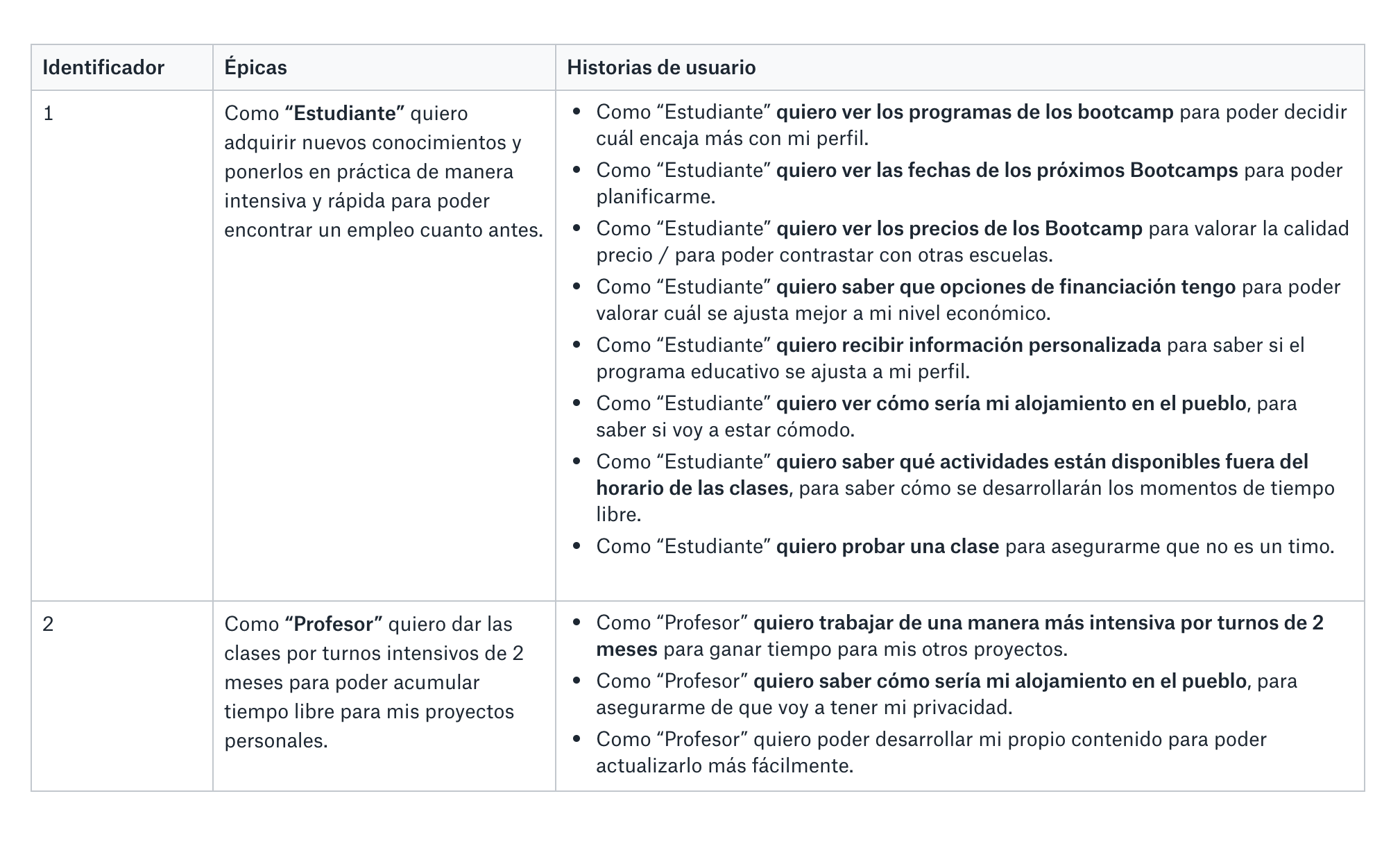
User stories are the smallest unit of work and are expressed as a benefit to users. They are used in the Scrum process.

We have marked two Epics, one for each profile of our target audience and we broke them up into User Stories.

Historias de usuario

We created MVP that allows us to perform data measurement and analysis.

To determine the validity of our hypothesis statements, we created the Minimum Viable Product (MVP) that allows us to perform data measurement and analysis. The result will determine whether we should continue developing the project, whether we should iterate on it or abandon it.

We have created a Landing Page in WordPress, launched it and carried out the measurements through the Google Analytics, Hotjar and Mailchimp tools.

Wireframes
Wireframes

We bet on a daring color range taking into account our target audience.

We decided to base the design on a vintage aesthetic and apply the collage technique to create the images. We bet on a daring color range taking into account the target audience, the young people from big cities.

To fit this risky bet with a technological world, we decided that the background would be white with a lot of space to create a contrast with the typography and graphic elements.

Guía de estilo

Video

We created a promotional video to show what the school and town are like.

Virtual sample class.

In order to show the users what our school classes are like, we bring this experience to them by creating a virtual sample class. On the Landing Page there is a sample video and visitors can request the class.

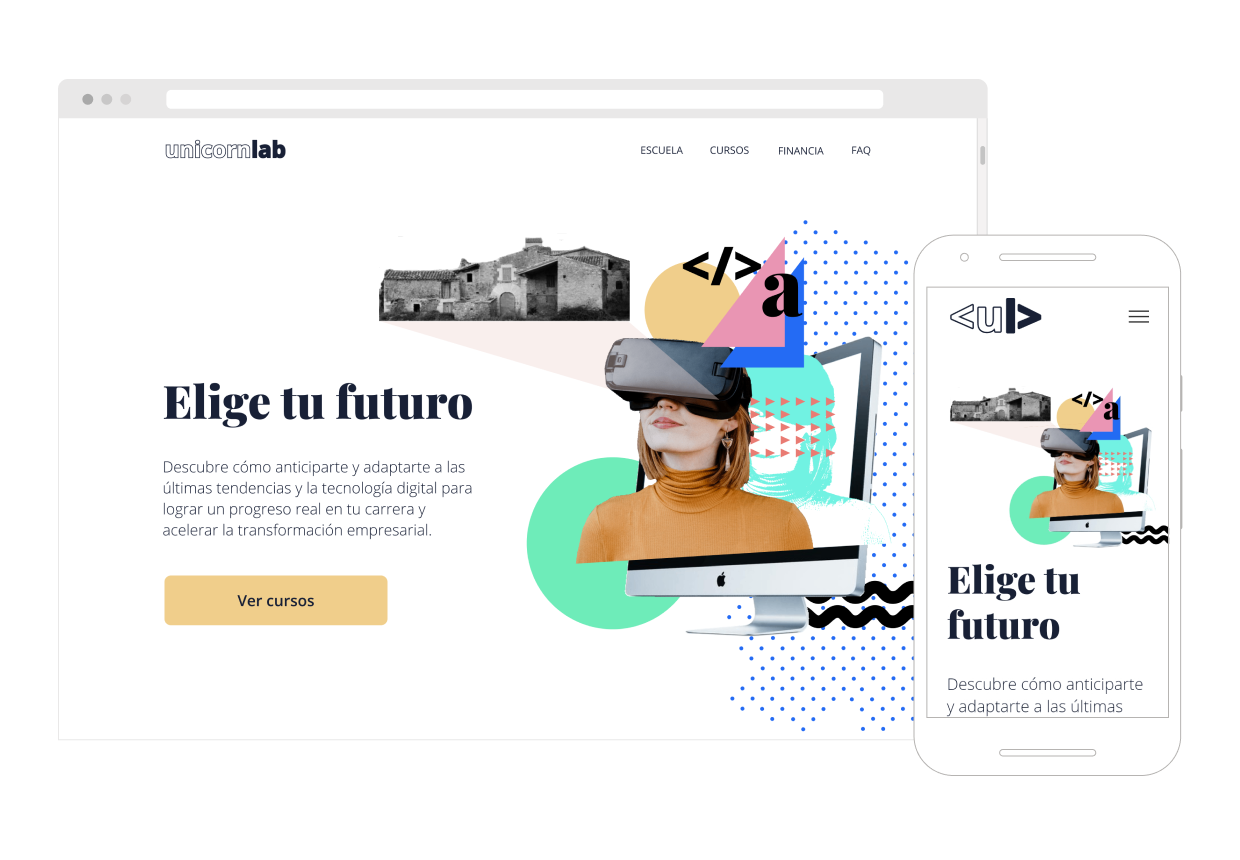
WordPress based Landing page

You can see the website in the video or vitit it on:

www.unicornlab.es

The launch scope was 100% organic.

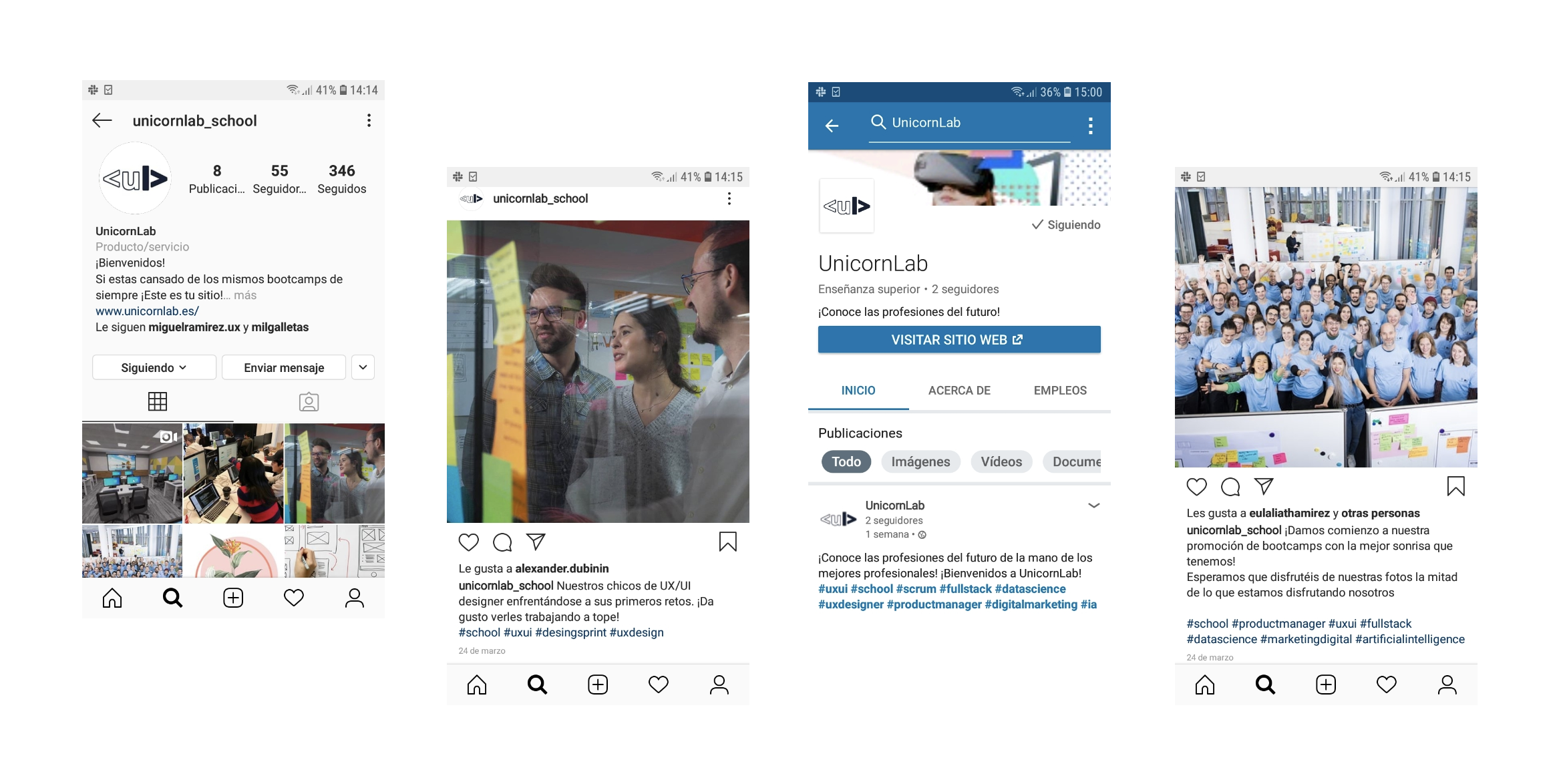
For the Landing page launch campaign, we have created school profiles on social media, created fictional posts and shared them online through our contacts and hashtags.

We decided not to invest in Facebook or Google ads, so the launch scope was 100% organic.

We also prepared an autoresponder in Mailchimp, so that a welcome email is automatically sent to users who request more information through the contact forms.

Lanzamiento en las redes sociales
Lanzamiento en Redes Sociales

We have placed an event on the CTA button in hero to minimize the bounce rate.

To capture the attention of the visitors who land on the page, the hero has a striking image, a persuasive copy and a CTA for users to see the courses and thus generate an action before it is necessary to scroll. We have placed an event on the CTA button to minimize the bounce rate.

In the rest of the sections, all the CTAs lead to a form to request more information. We have measured the number of clicks for each button with the Hotjar click map.

This way we were able to measure the interest in the different courses, in the financing and in the virtual sample class.

The form is linked to a Mailchimp list in order to measure the conversion rate.

We can evaluate the design of the form, seeing the difference between the number of clicks on the CTA to enter the form and the number of sent forms.

In the videos, we measured the number of views with the Hotjar click map and Vimeo statistics.
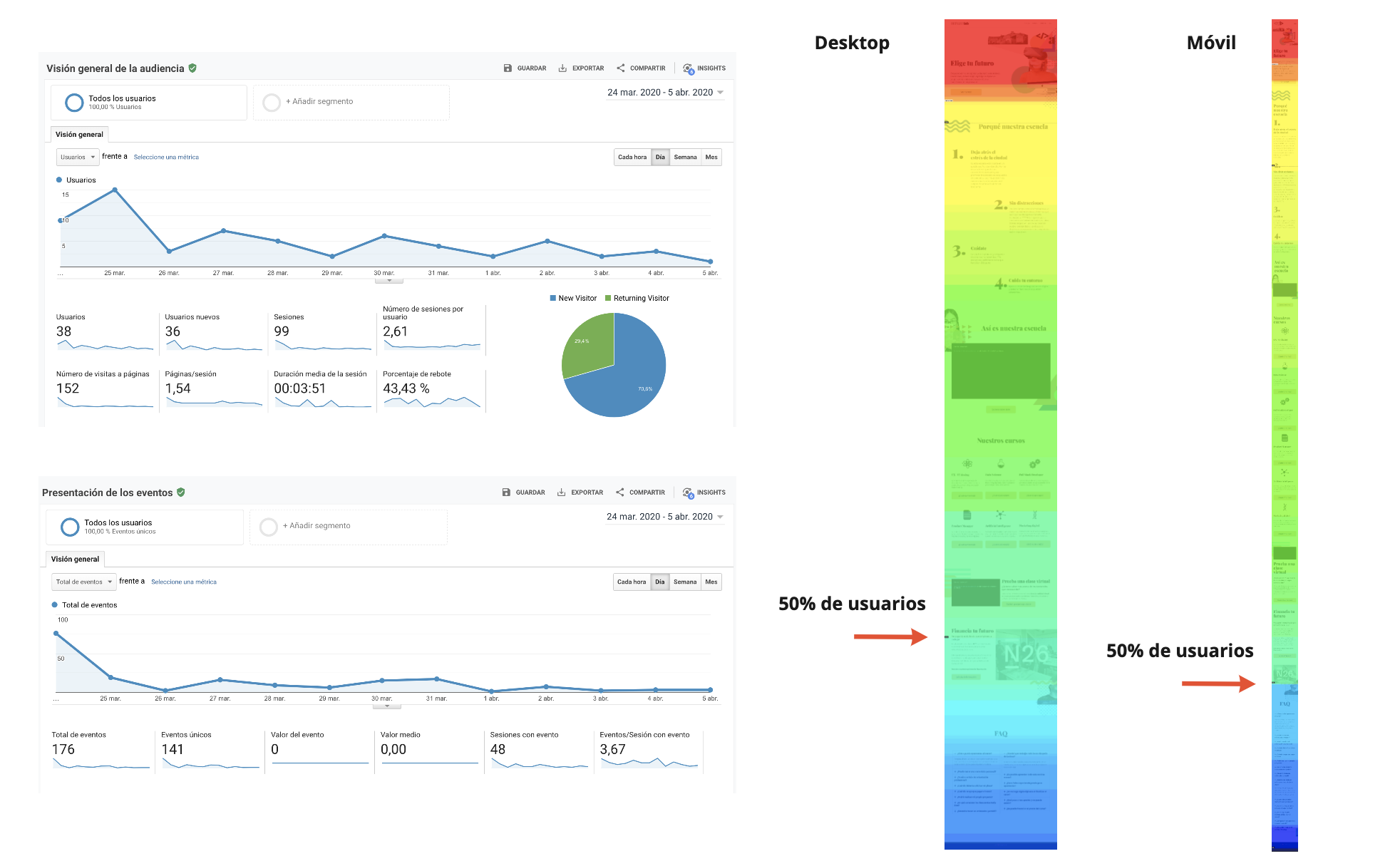
Resultados de métricas de Google Analitycs y Hotjar
Métricas Google Analitycs | Mapas de calor Hotjar

40% of the users reached the last section of the page.

We managed to generate interest.

The positive point is that we have achieved 152 visits to the Landing Page, out of which 29.4% were recurring visits. It means that the idea is interesting, users have returned to visit the page.

The average length of the sessions was 3.41 minutes and 40% of the users reached the last section of the page. We can say that the users read the contents, that the page length is correct and that the page is easy to consume.

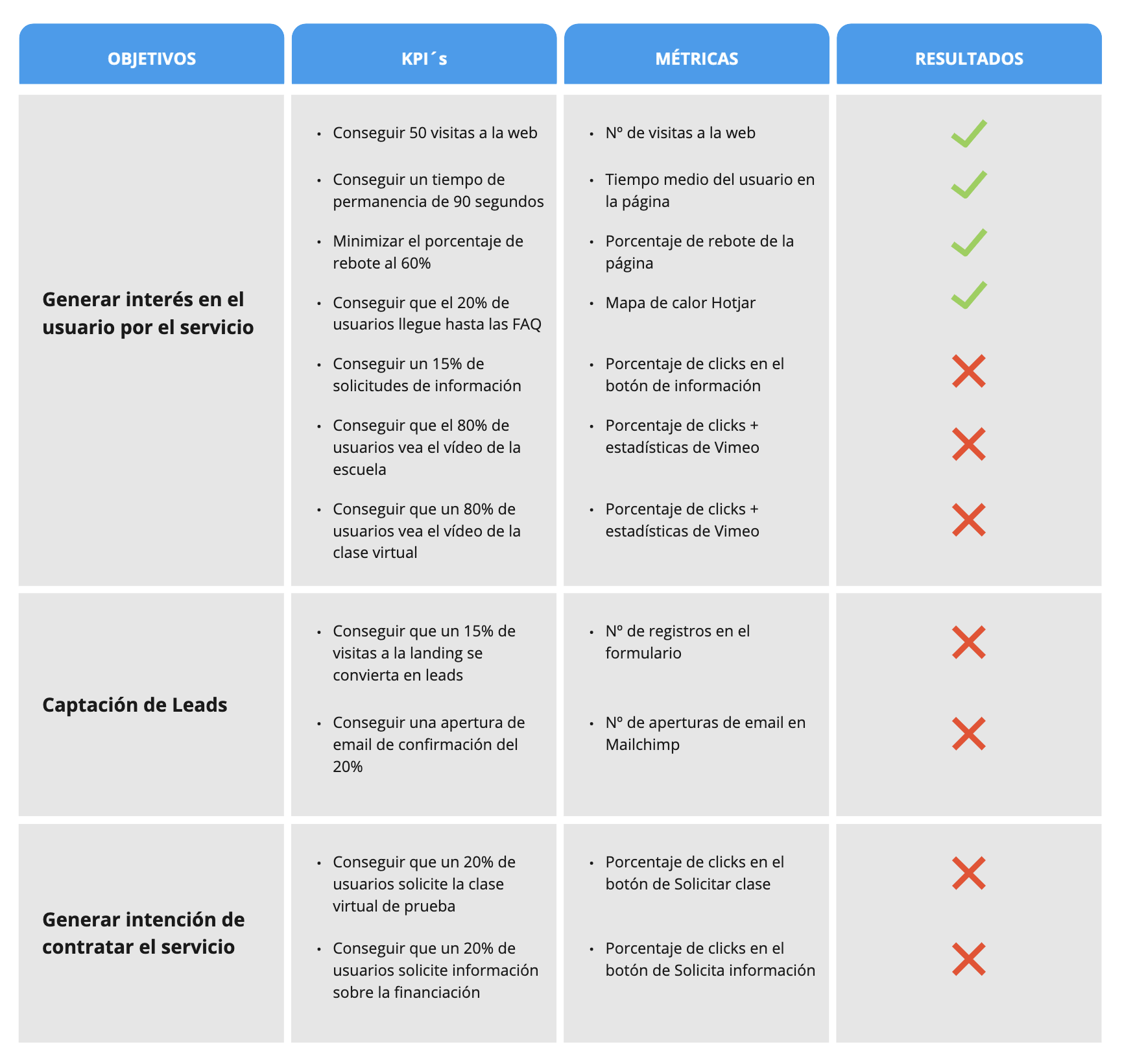
Métricas
Tabla de métricas

The KPI's we had set were too high.

We haven’t reached some of the KPI’s that we set:

  • capture the proposed nº of leads
  • the number of financing requests
  • the number of virtual class requests
  • the number of video views

One of the reasons may be that the KPI’s we had set were too high. Especially the conversion rates which are usually much lower in pages with few visits.

We launched the website a week after the Covid-19 lockdown had started.

The context and the time and budget constrains.

The Coronavirus situation is not the best moment for people to think about starting face-to-face classes.

Our web traffic was organic, with no investment in ads. (We have created a company account on Instagram and LinkedIn, we have created several posts and shared them).

We have detected points that we can iterate:

  • improve the reach of the campaign by investing in Ads (Facebook, Google)
  • improve the design so that users click on the videos
  • increase credibility by adding testimonials from alumni or information about teachers

We were able to obtain very valuable information to iterate, without tiring out our target audience.

We can make an improved version and launch it to our audience for the "first time".

We can conclude that the idea has generated interest and that after iterating the design and investing in a campaign with better reach, we would be able to collect more significant data.

Facebook and Instagram ads allow to target audience based on age, interests or location, making them a powerful tool for launch campaigns.

As we haven’t invested in advertising, we haven’t really reached our target audience. Despite this, we have been able to obtain very valuable information to iterate, without tiring out our target audience. It gives us the possibility to make an improved version and launch it to our audience for the “first time”.